
ARPwave Resources
The Era Beyond TENS: How Bioelectronic Medicine is Being Used for Everyday Pain and Injuries

Written by Shauna Reynolds, Certified ARPwave Therapist
ARPwave technology utilizes a patented Pulsed Direct Current (DC) to offer a drug-free solution for both minor daily tension and significant injury recovery, accessible through in-home protocols or clinical visits. [1]
Life is full of physical stressors. Whether you are ramping up for a new fitness goal, tackling a weekend of yard work, or simply dealing with the toll of a long commute, our bodies are constantly absorbing the impact of our daily activities. From repetitive motions to overexertion, lifestyle-related injuries are more common than many realize. Often, these “small” aches are ignored because they don’t seem significant enough to warrant a doctor’s visit.
However, ignoring minor discomfort is how many chronic conditions begin. ARPwave technology is changing that conversation by providing an alternative approach for many of lifes common aches and pains, all from the comfort of home.
From Tech Neck to DOMS: Common Ailments You Can Treat at Home
Many physical ailments fall into a “gray area”, they are annoying enough to affect your mood and performance but not “bad” enough to justify a clinical appointment. This is where ARPwave devices like the FlexDoctor shine as preventive and maintenance tools. We wish more people knew that we commonly witness significant improvement when applying our technology to everyday issues like:
- Desk Job” Tension & Postural Strain: Hours spent at a computer or on a phone often lead to localized discomfort in the neck and shoulders, commonly referred to as “tech neck.” While these may feel like minor complaints, daily tension can contribute to tension headaches and long-term postural issues if the underlying neurological signals aren’t addressed.
- Weekend Warrior” Recovery & DOMS: Whether it’s a long hike or a full day of yard work, that “good sore” feeling, technically known as Delayed Onset Muscle Soreness (DOMS), can quickly turn into ongoing stiffness and restricted movement.
- Foot Fatigue and “Heavy Legs”: Long days on your feet, whether from work, travel, or daily responsibilities, can lead to inflammation and soreness.
- Minor “Twinges“ and Acute Muscle Spasms: Sudden movements like reaching or lifting can cause small pulls or acute spasms. Ignoring these minor pulls allows the body to develop neurological compensation patterns that can lead to bigger issues.
- Repetitive Use or “Wear-and-Tear” Injuries: Continually repeated movements during daily activities like typing, lifting, or exercising can also lead to ongoing strain, especially when performed with poor posture or improper mechanics, which can cause wear and tear, limit mobility, and create further difficulties when left unaddressed.
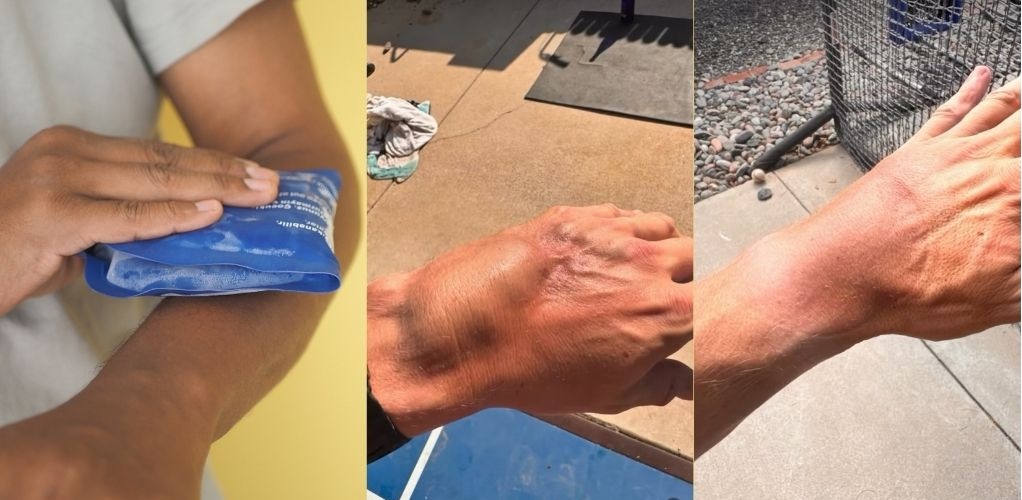
- Slips, Trips, and Unexpected Impact: Minor accidents often lead to more than just surface-level bruises and swelling. While the standard advice is to “rest and ice,” these impacts can “scare” the nervous system into a protective state that can lead to lingering stiffness. ARPwave technology acts as a neurological pump to help the body flush stagnant fluid and resolve bruising faster, while simultaneously resetting the protective reflex so you can return to normal movement without compensation.
- Stress and Overexertion: Busy schedules and physical demands often show up in the body as muscle tightness, fatigue, and tension-related pain. ARPwave helps reduce this buildup, promoting relaxation and supporting the body’s recovery from both physical and mental strain.
ARPwave’s Alternative to Rest, Ice, Compression, & Elevation (R.I.C.E)
While the results often speak for themselves, they support well-documented physiological responses and the broader principles of bioelectronic medicine:
- Managing the Full Spectrum of Swelling: While standard advice for a sudden impact is to “rest and ice,” research shows that early electrical intervention can be highly effective at managing acute swelling. Studies demonstrate that when specific sensory-level electrical currents are applied shortly after an injury, they significantly reduce acute swelling before it pools in the tissue. [2]
However, we commonly observe improvements in swelling that extend well beyond the initial acute phase. We propose that our unique waveform is a key reason for this. While some standard currents fail to resolve stagnant swelling, clinical evidence also suggests that using targeted pulsed current at intensities strong enough to induce muscle contractions, can significantly reduce chronic, long-standing edema [2]. We believe our specific waveform generates this by communicating the necessary muscle work to act as an active pump, to help flush out older, stagnant fluid and resolve lingering bruises.
- Tapping into Broad Bioelectric Healing (Skin, Muscle, and Bone): The scientific community is currently witnessing a massive shift toward “bioelectronic medicine”, or “electroceuticals.” A field utilizing precise electrical signals to facilitate healing rather than relying solely on pharmaceuticals. We see this revolution happening across all types of tissue—from wireless “smart bandages” that actively accelerate skin and wound healing, to the established use of constant direct current to treat unhealed bone fractures [3].
Because we commonly observe an acceleration in our users’ overall recovery timelines, including bone healing; we propose that our unique electrical waveform leverages these same bioelectric principles. By speaking the electrical language of the body, the technology provides a deep-tissue environment optimized for complete recovery.
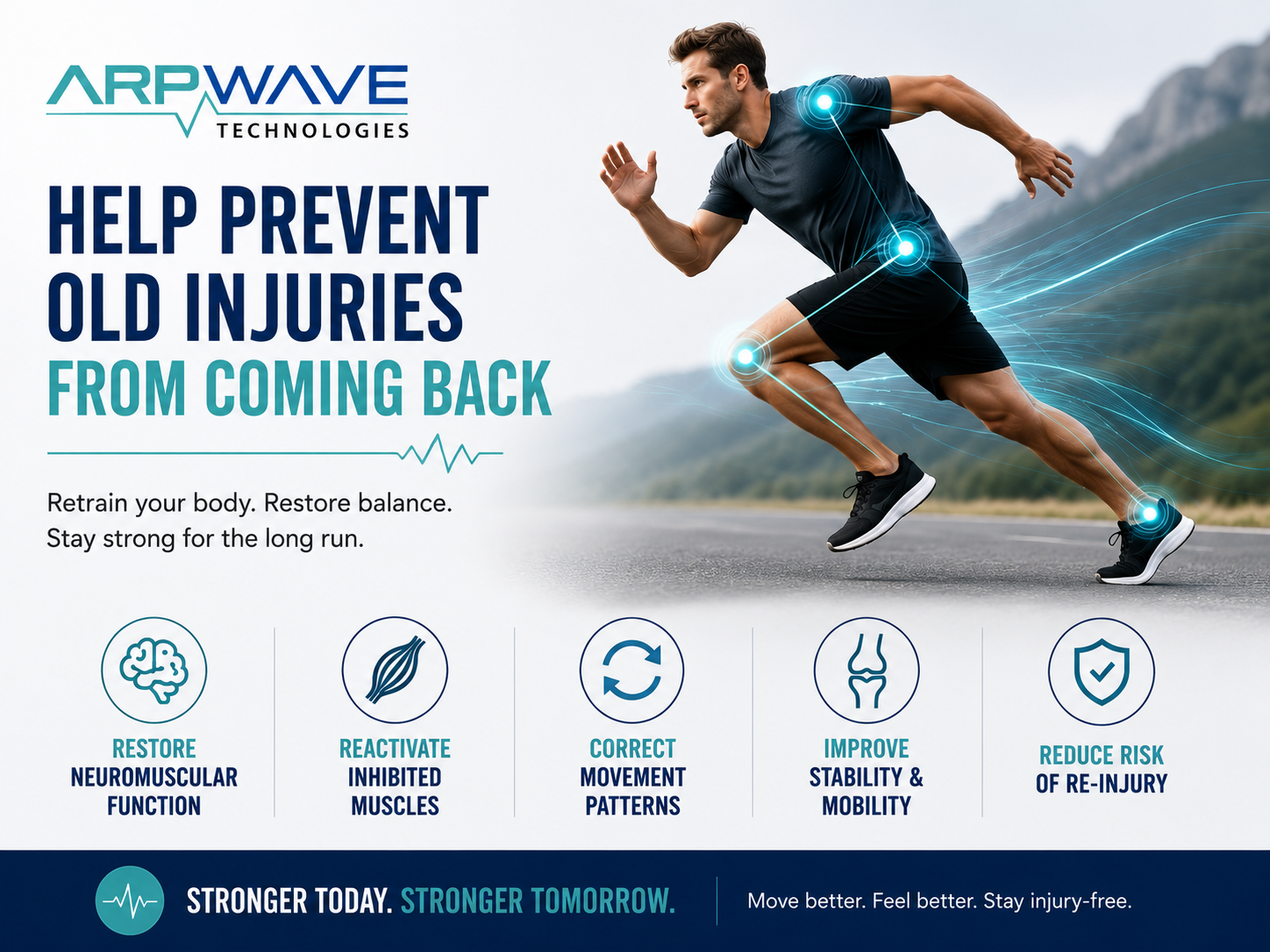
- Working With the Body’s “Safety Switch”: It is a common misconception that the brain simply “shuts down” a muscle to protect it after an injury. In reality, this weakness—known clinically as Arthrogenic Muscle Inhibition (AMI), is more of an involuntary reflex [4]. Targeted electrical stimulation can act as a reset button. Experts note that treating this inhibition requires repeated, serial interventions to open a “therapeutic window” in which the nervous system allows these muscles to be used fully again [5].
- Generating Work Without the Fatigue: A common question is how this differs from a standard TENS unit. While a standard TENS device uses Alternating Current (AC) to mask pain symptoms temporarily, it does little to address the underlying dysfunction. Research confirms that Pulsed Current (PC), which our waveform utilizes, is significantly less fatigable than standard AC [6]. Because our unique waveform can generate substantial muscle work and handle higher mechanical loads without tiring the muscles, it allows users to move freely during use and rebuild strength.
Bringing Professional Recovery Home with the FlexDoctor
For those looking to take a proactive approach, ARPwave devices like the FlexDoctor offer an accessible way to consistently address lifes aches and pains. The FlexDoctor allows users to work on areas of pain and restriction at home, helping to improve mobility, restore strength, and reduce everyday discomfort.
By incorporating ARPwave into the process you would normally use when reaching for an ibuprofen, many individuals find they can move better, feel stronger, and return to daily activities with greater ease.
Safety and Considerations
ARPwave devices are FDA-cleared and safe for a wide range of users. However, it should not be used by individuals with pacemakers, those who are pregnant, or those with a history of blood clots. Always consult with a healthcare professional before beginning a new therapy protocol for chronic conditions.
Conclusion
Everyday life brings a wide range of physical demands, but living with discomfort doesn’t have to be the norm. By addressing issues early and using advanced solutions like the FlexDoctor, you can resolve dysfunction before it becomes limiting.
While the FlexDoctor provides an at-home solution, those in the Twin Cities area can visit our Apple Valley, MN clinic for a professional in-person assessment to help with their discomfort.
Learn more about the FlexDoctor here.
Resources:
[1]
Vincent De Bono, D. C. ARP, The RC Circuit And Arthrogenic Muscle Inhibition. https://www.motustherapeuticmethods.com/news/2023/5/5/arp-neuro-the-r-c-circuit-and-arthrogenic-muscle-inhibition
[2]
Mendel, F. C., & Fish, D. R. (1993). New Perspectives in Edema Control via Electrical Stimulation. Journal of athletic training, 28(1), 63–74. https://pmc.ncbi.nlm.nih.gov/articles/PMC1317894/
[3]
Jiang, Y., Trotsyuk, A. A., Niu, S., Henn, D., Chen, K., Shih, C.-C., Larson, M. R., Mermin-Bunnell, A. M., Mittal, S., Lai, J.-C., Saberi, A., Beard, E., Jing, S., Zhong, D., Steele, S. R., Sun, K., Jain, T., Zhao, E., Neimeth, C. R., … Bao, Z. (2023). Wireless, closed-loop, smart bandage with integrated sensors and stimulators for advanced wound care and accelerated healing. Nature Biotechnology, 41(5), 652–662. https://doi.org/10.1038/s41587-022-01528-3
[4]
Rice, D. A., & McNair, P. J. (2010). Quadriceps Arthrogenic Muscle Inhibition: Neural Mechanisms and Treatment Perspectives. Seminars in Arthritis and Rheumatism, 40(3), 250–266. https://doi.org/10.1016/j.semarthrit.2009.10.001
[5]
Norte, G. E., Sherman, D. A., Rush, J. L., Ingersoll, C. D., Bodkin, S. G., Snyder-Mackler, L., Grindstaff, T. L., Burland, J. P., Hopkins, J. T., Blackburn, T., Chaput, M., Konishi, Y., Rice, D. A., Hart, J. M., Harkey, M. S., Zarzycki, R., Palmieri-Smith, R. M., Lepley, L. K., Lepley, A. S., … Kuenze, C. M. (2024). Advancing Clinical Evaluation and Treatment of Arthrogenic Muscle Inhibition: A Need for Validation and Innovation—Letter to the Editor. The American Journal of Sports Medicine, 52(12), NP34–NP36. https://doi.org/10.1177/03635465241272410
[6]
Paz, I. de A., Rigo, G. T., Sgarioni, A., Baroni, B. M., Frasson, V. B., & Vaz, M. A. (2021). Alternating Current Is More Fatigable Than Pulsed Current in People Who Are Healthy: A Double-Blind, Randomized Crossover Trial. Physical Therapy, 101(6), Article 101. https://doi.org/10.1093/ptj/pzab056