
ARPwave Resources
Hamstring Pain: Causes, Recovery Timeline, Exercises & ARPwave Therapy

Clinically Reviewed by the ARPwave Clinical Education Team
Hamstring Pain: Causes, Exercises, Recovery Timeline, and ARPwave Therapy Solutions
This article is for educational purposes only and is not a substitute for medical diagnosis or treatment. If you have severe hamstring pain, numbness, tingling, weakness, difficulty walking, significant bruising, or concern for a tear, consult a qualified healthcare professional.
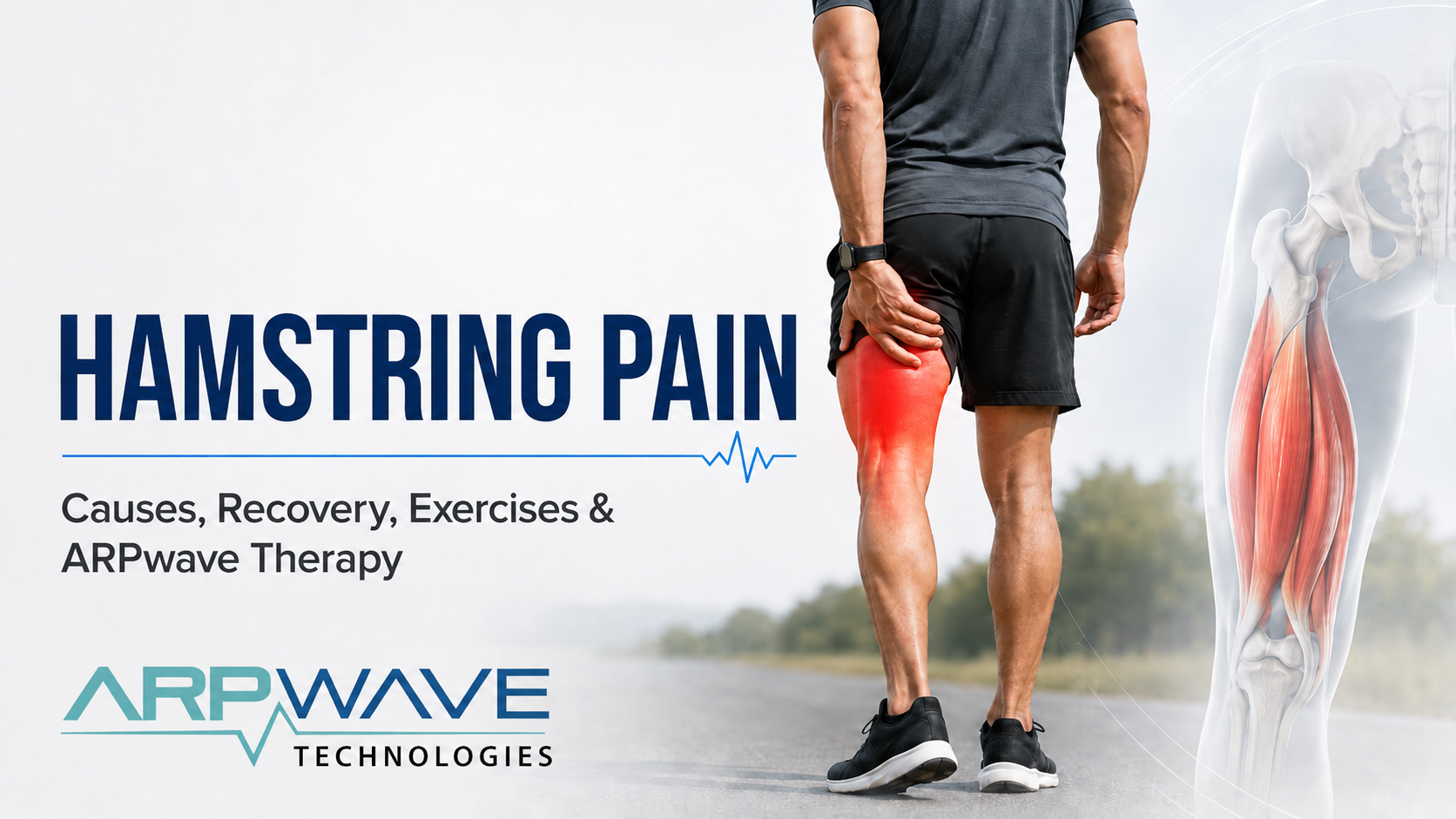
Hamstring pain is one of the most common issues affecting athletes, runners, active adults, workers, and people who sit for long periods of time. It can feel like tightness, soreness, pulling, cramping, sharp pain, weakness, or pain that travels through the back of the thigh. For some people, hamstring pain starts suddenly during sprinting, jumping, lifting, or changing direction. For others, it builds slowly over time and becomes noticeable while sitting, walking, driving, running, or exercising.
The challenge is that not all hamstring pain is the same. Pain in the back of the thigh may come from a pulled hamstring, hamstring strain, tendon irritation, sciatic nerve involvement, weakness, compensation, or poor neuromuscular control. That is why the best solution is not simply rest, stretching, or pushing through the pain. The better question is: why is the hamstring hurting in the first place?
ARPwave Therapy may be part of the solution for people who need more than temporary relief. By combining proprietary electrical stimulation technology with guided movement, ARPwave Therapy is designed to help improve neuromuscular communication, activate muscles more efficiently, identify dysfunctional areas, and support a faster return to function.
For many patients and athletes, ARPwave Therapy may help accelerate recovery by improving neuromuscular activation and restoring better movement patterns faster than rest or stretching alone. The goal is not just to make the hamstring feel better. The goal is to restore function.
Quick Answer: What Helps Hamstring Pain?
Hamstring pain relief depends on the cause. A mild hamstring strain may improve with reduced activity, ice, compression, gentle movement, and progressive strengthening. Recurring hamstring pain may require a deeper approach that addresses muscle activation, compensation, hip and pelvic control, sciatic nerve involvement, and neuromuscular communication.
ARPwave Therapy may help support hamstring recovery by combining proprietary electrical stimulation with guided movement to improve activation, movement quality, and functional recovery. The goal is not just to relieve discomfort temporarily, but to help the body restore better communication, better movement, and better function.
What Is the Hamstring?
The hamstring is a group of three muscles located on the back of the thigh. These muscles help bend the knee, extend the hip, stabilize the pelvis, and control the leg during walking, running, jumping, climbing, sprinting, and slowing down. Because the hamstrings cross both the hip and knee joints, they are heavily involved in movement and stability.
The hamstring muscles include the biceps femoris, semitendinosus, and semimembranosus. Each muscle plays a slightly different role, but together they help control the lower body during movement. They are especially important during high-speed activity, deceleration, hip extension, knee flexion, and sports movements that require sudden stops, starts, or directional changes.
Hamstring injuries are common because these muscles are placed under significant stress during both everyday movement and athletic performance. A person does not have to be a professional athlete to experience hamstring pain. It can happen from sports, work, training, prolonged sitting, weakness, compensation, or returning to activity too quickly after injury.
Common Hamstring Pain Symptoms
Hamstring pain can feel different depending on the cause, location, and severity of the issue. Some people feel a sudden sharp pull in the back of the thigh. Others feel a deep ache near the sitting bone. Some describe tightness, cramping, weakness, or pain that worsens when walking, sitting, running, climbing stairs, or bending forward.
A mild hamstring issue may feel like soreness or tightness. A more serious injury can cause bruising, swelling, sharp pain, and difficulty walking. If the injury happens suddenly, a person may feel or hear a pop. In that case, the injury may be more significant and should be evaluated.
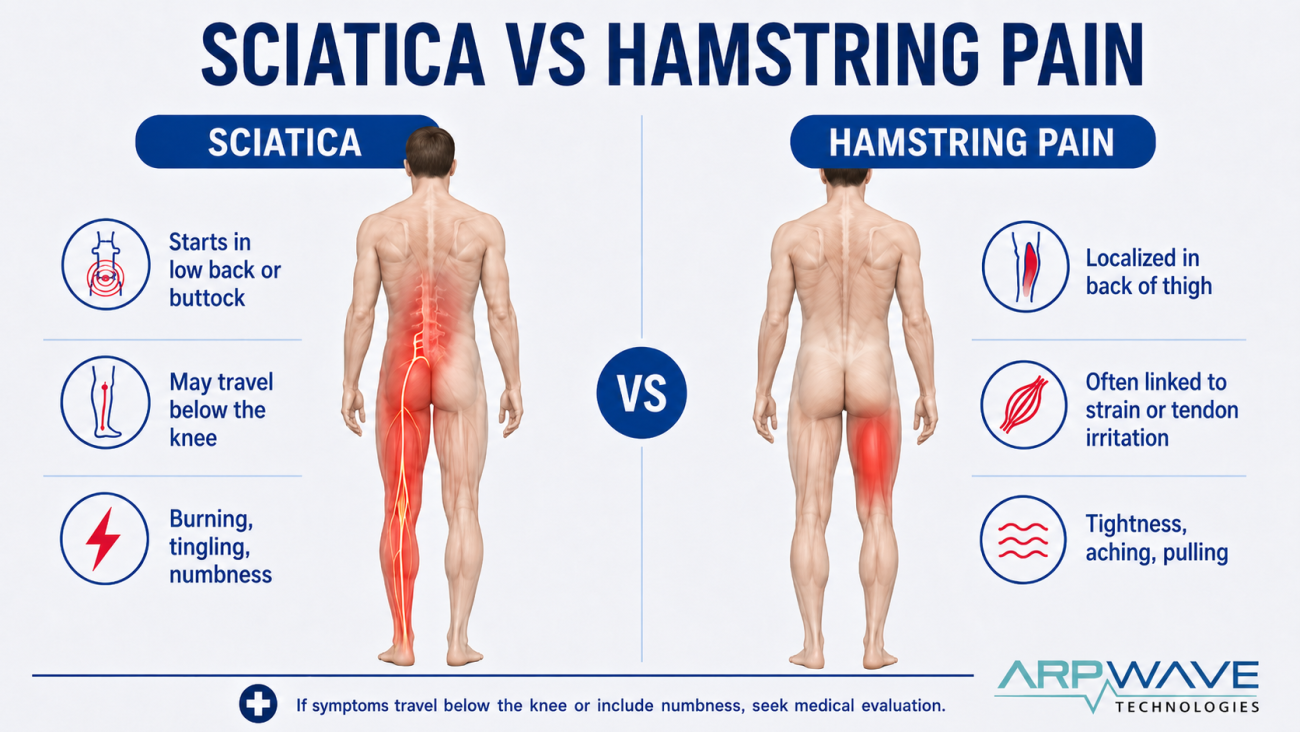
The location of the pain matters. Pain in the middle of the back of the thigh may suggest a muscle strain. Pain near the sitting bone may involve the upper hamstring tendon or nearby nerve structures. Pain that starts in the low back or buttock and travels down the leg may point toward sciatic nerve irritation.
This is one reason hamstring pain can be confusing. The hamstring may be where the pain is felt, but it may not always be the only source of the problem.
What Causes Hamstring Pain?
Hamstring pain can come from several different sources. Understanding the cause is important because a muscle strain, tendon problem, and sciatic nerve issue should not all be treated the same way.
Hamstring Strain
A hamstring strain, often called a pulled hamstring, happens when the muscle fibers are overstretched or torn. This can occur suddenly during sprinting, jumping, kicking, lunging, lifting, or changing direction. A hamstring strain may feel like a sharp pull, tear, or snap in the back of the thigh. Some people feel a pop at the time of injury.
Hamstring strains can range from mild to severe. A mild strain may create soreness and tightness but still allow someone to walk. A moderate strain may cause more pain, weakness, and limited movement. A severe strain or tear may cause significant bruising, swelling, difficulty walking, and loss of strength.
Hamstring Tendon Irritation
Hamstring tendon pain often occurs near the top of the hamstring, close to the lower buttock or sitting bone. This may involve the proximal hamstring tendon. Instead of a sudden sharp injury, tendon pain may build gradually and become worse with sitting, running, deadlifting, lunging, climbing stairs, bending forward, or driving for long periods of time.
This type of pain can be frustrating because it may not always feel like a classic muscle pull. A person may be able to walk but still have pain when sitting, running, or loading the hamstring. Tendon-related pain often requires a careful progression of activity, strength, and load management.
Sciatic Nerve Irritation
Not every pain in the back of the thigh is a hamstring injury. The sciatic nerve runs from the low back through the buttock and down the back of the leg. When irritated, it can create pain that feels like hamstring tightness, pulling, burning, tingling, numbness, or electric-like symptoms.
This is why many people search for how to tell the difference between sciatica and hamstring pain. The two can feel similar, but the underlying problem can be very different. Hamstring pain is often more local to the back of the thigh or sitting bone. Sciatica often starts in the low back or buttock and may travel farther down the leg.
 Weakness and Poor Neuromuscular Control
Recurring hamstring pain is often not just a tissue problem. It can also be a communication problem. The hamstring works with the glutes, hips, pelvis, core, low back, knees, calves, and feet. If one part of that system is not working well, the hamstring may become overloaded.
For example, if the glutes are not activating properly, the hamstring may take on more work than it should. If the pelvis is unstable, the hamstring may guard. If the nervous system senses poor control, the hamstring may feel tight even if it is not truly short.
This is a major reason ARPwave Therapy focuses on neuromuscular communication and guided movement instead of simply chasing the painful area. A hamstring that keeps getting injured may not just need more stretching. It may need better communication, better activation, and better movement control.
Returning Too Soon After Injury
Another common cause of recurring hamstring pain is returning to activity too quickly. Pain may improve before the muscle, tendon, and nervous system are fully ready. If someone goes back to sprinting, heavy lifting, training, or sports too early, the risk of reinjury increases.
A hamstring can feel better before it is actually ready to perform. That is why a complete recovery plan should look beyond pain and include strength, movement quality, confidence, and function.
Hamstring Strain vs. Hamstring Tendon Pain
A hamstring strain and hamstring tendon pain can both cause pain in the back of the thigh, but they often feel different. A hamstring strain usually happens suddenly and is often linked to a specific movement, such as sprinting, jumping, lunging, or changing direction. It may cause sharp pain, a pulling sensation, bruising, swelling, weakness, and difficulty walking or running.
Hamstring tendon pain often builds over time and is commonly felt near the lower buttock or sitting bone. It may become more noticeable while sitting, driving, running, lifting, lunging, or bending forward. Instead of feeling like a sudden tear, it may feel like a deep ache, irritation, or recurring pain that returns when activity increases.
The difference matters because treatment should match the source of the problem. Aggressive stretching may not help tendon irritation. Rest alone may not restore the strength and coordination needed to prevent the issue from coming back. A complete approach should identify the source of pain, calm irritation, restore activation, rebuild strength, and return the person to real function.
How to Relieve Hamstring Pain
Relieving hamstring pain starts with understanding what is causing it. A fresh strain, chronic tendon irritation, and sciatic nerve problem should not be treated the same way. In the early stage after a sudden injury, reducing painful activity may help calm irritation. Ice, compression, and elevation may also be useful when swelling is present.
However, rest is not the full solution. Rest may reduce symptoms, but it does not always restore strength, coordination, or movement quality. Many people feel better temporarily, return to activity, and then reinjure the same area because the underlying issue was never fully addressed.
A better long-term approach focuses on restoring comfortable movement, improving muscle activation, rebuilding strength, and correcting compensation patterns. This means the recovery process should gradually move from symptom control to functional movement.
ARPwave Therapy may fit into this stage by helping identify areas of dysfunction and improving how the nervous system communicates with the muscles during movement. Instead of only treating the painful spot, ARPwave Therapy looks at the larger system behind the pain.
How to Tell the Difference Between Sciatica and Hamstring Pain
Sciatica and hamstring pain can overlap because both can create symptoms in the back of the thigh. The key difference is usually the type of pain, where it starts, and how far it travels.
Hamstring pain is often more local. It may stay in the back of the thigh or near the sitting bone. It may be worse with sprinting, walking, running, bending the knee, stretching the hamstring, climbing stairs, lunging, deadlifting, or pressing on the injured area. A hamstring injury may also cause bruising, swelling, or a clear moment of injury.
Sciatica is usually more nerve-like. It may start in the low back or buttock and travel down the leg. It may include burning, tingling, numbness, electric sensations, pain below the knee, or symptoms that change with spine position. Sitting, bending, coughing, or sneezing may also aggravate sciatic symptoms.
A simple way to think about it is this: hamstring pain is usually more local, while sciatica is usually more traveling, nerve-like, or connected to the back and buttock. If pain travels below the knee, includes numbness, tingling, or weakness, or does not improve, medical evaluation is important.
Why Does My Hamstring Hurt While Sitting?
Hamstring pain while sitting often involves the upper hamstring tendon, the sitting bone area, or nearby nerve structures. This pain is commonly felt near the lower buttock or upper back of the thigh. It may become worse during long drives, desk work, sitting on hard surfaces, or sitting after running or lifting.
Sitting can place pressure near the proximal hamstring tendon and surrounding tissue. If the tendon is irritated, that pressure can make symptoms worse. If the sciatic nerve is involved, sitting may also increase nerve sensitivity and create pain that feels like hamstring tightness or pulling.
If sitting is the main trigger, forcing the hamstring into deeper stretches may not solve the problem. The better approach is usually to reduce irritation, improve hip and pelvic control, strengthen the posterior chain, and determine whether nerve involvement is present.
ARPwave Therapy may help support this process by combining neuromuscular stimulation with guided movement. The goal is to improve activation and coordination instead of only treating the painful area.
Why Does My Hamstring Hurt While Walking?
Hamstring pain while walking may happen when the hamstring is still healing, the tendon is irritated, the sciatic nerve is sensitive, or the body is compensating around another issue. The hamstrings help control the leg as it swings forward and help extend the hip as the body moves forward. If the hamstring is injured or not coordinating properly, even normal walking can become painful.
Walking pain may also show that the body is guarding. A person may shorten their stride, avoid loading one side, overuse the opposite leg, or compensate through the low back, hip, knee, or calf. These compensations may help temporarily, but they can create new problems if they continue.
If walking causes limping, sharp pain, swelling, bruising, or weakness, the injury should be evaluated. For people who continue to experience hamstring pain while walking after rest or basic rehab, ARPwave Therapy may help identify compensation patterns and improve how the nervous system communicates with the muscles during functional movement.
Best Hamstring Exercises for Pain and Injury Recovery
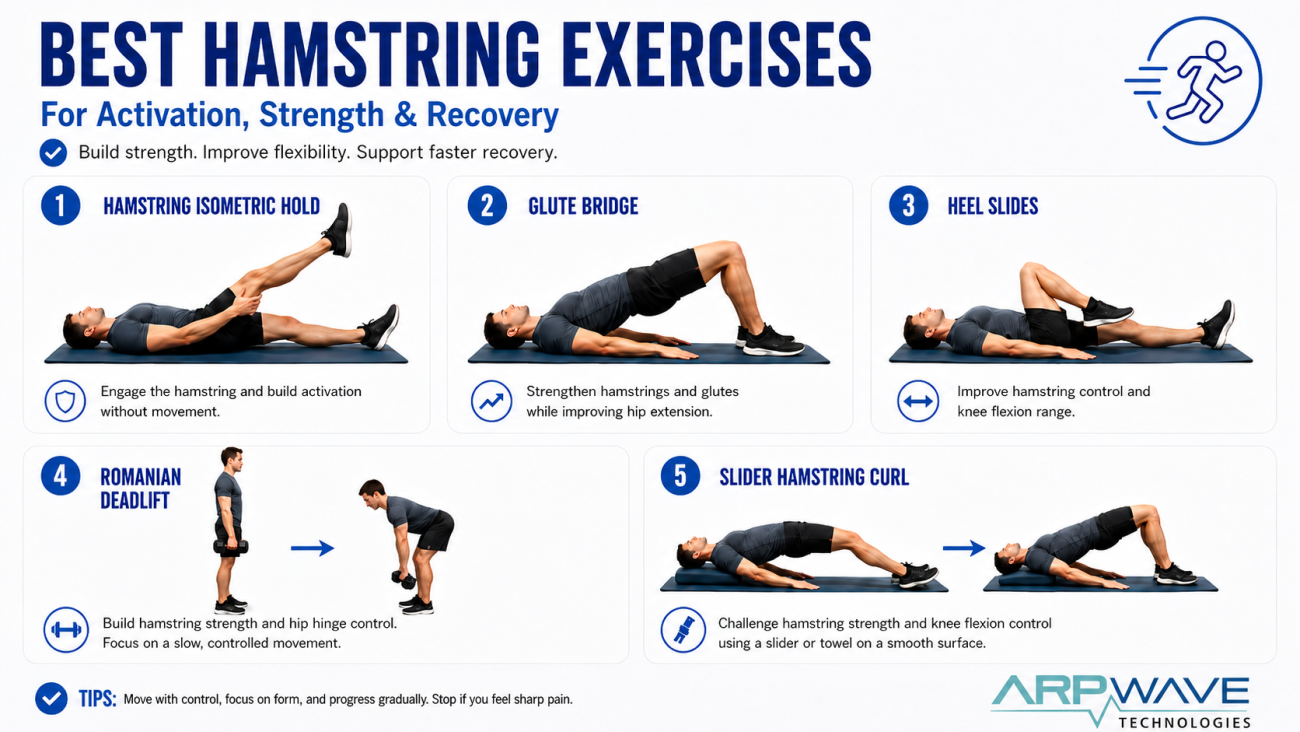
The best hamstring exercises depend on the stage of recovery. Early exercises should not be the same as late-stage return-to-sport exercises. The goal is to progress from gentle activation to strength, control, and functional movement.
A hamstring isometric hold is often a useful early-stage exercise because it activates the hamstring without large movement. The person lies on their back with the knee bent and gently presses the heel into the floor as if trying to drag it toward the body, without actually moving the foot. This helps activate the hamstring without overstressing the injured tissue.
The glute bridge helps improve the connection between the glutes and hamstrings. This matters because if the glutes are not contributing well, the hamstring may become overloaded. During a glute bridge, the person lies on their back with knees bent, pushes through the heels, lifts the hips, and squeezes the glutes at the top. The movement should be controlled and pain-free.
Heel slides help restore comfortable knee motion and hamstring control. The person lies on their back and slowly slides one heel toward the body, then slides it back out. This should feel controlled rather than forced.
The hip hinge is important because many hamstring problems are connected to poor hip and pelvic control. A person should learn to move through the hips while keeping the spine controlled. The goal is not to stretch aggressively. The goal is to teach the body how to load the posterior chain properly.
The Romanian deadlift is a more advanced strengthening exercise that should be introduced only when basic movement is pain-free. It helps build strength through the hamstring and glute system. Light resistance and slow movement are important in the beginning.
Slider hamstring curls and Nordic hamstring curls may be useful later in recovery, especially for athletes and people returning to higher-level activity. These exercises can help improve eccentric strength, but they should be introduced gradually and only when the hamstring is ready for higher loads.
Hamstring exercises are important, but exercise quality matters. If the body is compensating, guarding, or failing to activate the right muscles, the person may perform exercises without truly solving the problem. ARPwave Therapy may help support exercise progression by improving neuromuscular activation, identifying dysfunctional areas, and helping the body coordinate movement more efficiently.
 Should You Stretch a Painful Hamstring?
 Should You Stretch a Painful Hamstring?
Sometimes stretching helps. Sometimes it makes the problem worse. Stretching may be appropriate if the issue is mild tightness and there is no acute tear, nerve irritation, sharp pain, or worsening symptoms afterward. However, if the injury is new, bruised, swollen, sharp, or nerve-like, aggressive stretching may increase symptoms.
Many people assume tightness means the hamstring needs more stretching. That is not always true. The hamstring may feel tight because the nervous system is protecting the area. In that case, strengthening, stability, activation, and movement retraining may be more effective than stretching alone.
This is one of the reasons ARPwave Therapy can be valuable for recurring hamstring issues. It focuses on neuromuscular function, not just tissue tightness. The goal is to help the body communicate better, activate better, and move better.
Hamstring Pain and the Nervous System
The hamstring does not work alone. It is part of a larger system involving the low back, pelvis, hips, glutes, knees, calves, feet, and nervous system. When one part of that system is not communicating or coordinating well, another area may compensate.
Over time, compensation can create pain, tightness, recurring strains, and performance limitations. A complete hamstring recovery plan should look at how the person walks, sits, hinges, squats, runs, loads the hamstring, uses the glutes, controls the pelvis, and responds to nerve tension.
ARPwave Therapy is built around this concept. The goal is not simply to treat the spot that hurts. The goal is to improve communication, activation, movement, and function across the system.
The hamstring may be where the pain is felt, but it may not be the only problem.
How Long Does Hamstring Pain Take to Heal?
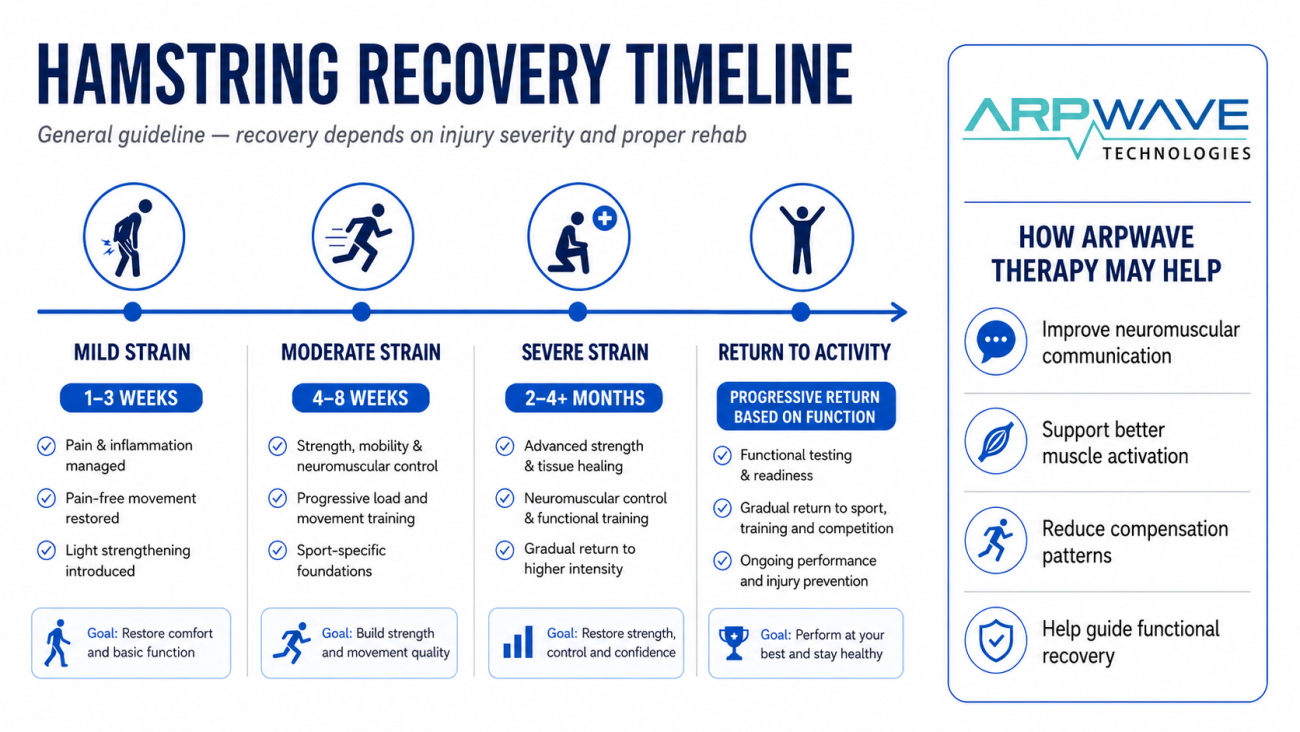
Hamstring recovery timelines depend on the severity of the injury, the location of the pain, and whether the issue involves the muscle, tendon, sciatic nerve, or a deeper movement compensation.
A mild hamstring strain may improve in a few days to a few weeks. A moderate hamstring injury may take several weeks. A more severe tear, tendon injury, or surgical repair may require months of rehabilitation before returning to full activity.
But time alone does not equal recovery. Many people feel better before they are actually ready to sprint, lift, walk long distances, return to sport, or resume full activity. Pain may decrease, but the nervous system, muscle activation, strength, and movement pattern may still be incomplete. This is one reason hamstring injuries can come back.
A better recovery timeline should include pain-free walking, improved range of motion, restored hamstring and glute activation, improved strength, better hip and pelvic control, the ability to load the hamstring safely, confidence during movement, and a gradual return to activity, sport, or work.
Can ARPwave Therapy Help Accelerate Hamstring Recovery?
 Can ARPwave Therapy Help Accelerate Hamstring Recovery?
ARPwave Therapy may help support faster and more complete recovery by addressing one of the biggest missing pieces in hamstring rehab: neuromuscular communication.
Traditional recovery often focuses on rest, stretching, strengthening, and time. Those can all be important, but they may not fully address why the hamstring became overloaded or why the body continues to guard, compensate, or move inefficiently after injury.
ARPwave Therapy combines proprietary electrical stimulation technology with guided movement to help identify areas of dysfunction, improve muscle activation, and support better communication between the nervous system and the muscles. When the body can recruit the right muscles more efficiently and move with better control, patients may be able to progress through recovery more effectively.
For hamstring injuries, ARPwave Therapy may help support faster improvement in muscle activation, better glute and hamstring coordination, reduced compensation patterns, improved movement quality, more efficient strengthening, increased confidence during walking, training, or sport, and a more complete return to function.
This is why ARPwave is often used by athletes, active adults, and providers looking for more than passive recovery. The goal is not just to wait for the hamstring to feel better. The goal is to restore function faster and reduce the risk of the same injury coming back.
ARPwave does not simply focus on pain. It focuses on the system behind the pain: communication, activation, movement, and function.
Traditional Hamstring Rehab vs. ARPwave Therapy
Traditional hamstring rehab often focuses on rest, stretching, strengthening, manual therapy, and gradual return to activity. These can all be valuable parts of recovery, especially when they are matched to the type and severity of the injury. A mild hamstring strain may respond well to reduced activity, progressive movement, and strengthening. A more severe injury may require imaging, professional evaluation, or a longer rehabilitation timeline.
The challenge is that many people continue to deal with recurring hamstring pain even after rest, stretching, massage, physical therapy, injections, or time off. In those cases, the issue may not be only the hamstring muscle. It may involve how the nervous system is communicating with the muscles, how the glutes and hamstrings coordinate, how the pelvis moves, or how the body compensates during walking, running, lifting, or sport.
ARPwave Therapy takes a different approach by combining proprietary electrical stimulation technology with guided movement. Instead of only focusing on the painful area, ARPwave Therapy is designed to help identify areas of dysfunction, improve neuromuscular communication, activate muscles more efficiently, and support better functional movement.
For hamstring pain, this matters because the hamstring rarely works alone. It depends on proper communication between the low back, pelvis, glutes, hips, knees, calves, feet, and nervous system. If one part of that system is not working well, the hamstring may become overloaded, guarded, tight, or vulnerable to reinjury.
Traditional rehab may ask the hamstring to stretch or strengthen. ARPwave Therapy works to improve how the body communicates with the hamstring and surrounding muscles during movement. That can help patients and athletes progress more efficiently from pain-limited movement toward better strength, coordination, confidence, and function.
The goal of ARPwave Therapy is not simply to make the hamstring feel better for a short period of time. The goal is to help restore function faster and support a more complete return to activity.
When Is Hamstring Surgery Needed?
Most hamstring injuries do not require surgery. Surgery may be discussed when there is a complete tendon tear, tendon avulsion from the bone, significant tendon retraction, severe weakness, major loss of function, failure of conservative care, high-level athletic demands, or a chronic proximal hamstring injury that does not improve.
Surgery is a serious decision and should be based on imaging, function, symptoms, goals, and professional medical evaluation. Even when surgery is needed, recovery does not end when the tissue is repaired. The body still needs to restore strength, movement, coordination, confidence, and function.
ARPwave Therapy may be considered as part of a post-injury or post-surgical recovery strategy when appropriate and guided by a qualified provider. The purpose is not to replace medical evaluation or surgical decision-making. The purpose is to support the functional side of recovery by helping the body restore better communication and movement.
ARPwave Therapy for Hamstring Pain and Injury Recovery
ARPwave Therapy is a neuromuscular therapy system that combines proprietary electrical stimulation technology with guided movement. For hamstring pain, the goal is not simply to chase symptoms. The goal is to help the body improve communication, activation, movement, and function.
Many traditional approaches focus on the painful area alone. ARPwave looks at the broader system. A hamstring problem may involve the hamstring, but it may also involve the glutes, hip flexors, pelvis, low back, core, calves, feet, sciatic nerve, movement compensation, or poor neuromuscular activation.
When one area is not working well, another area may compensate. Over time, that compensation can create pain, tightness, recurring strains, and limited performance. ARPwave Therapy may help support neuromuscular activation, muscle recruitment, movement retraining, functional strengthening, compensation reduction, injury recovery, return-to-activity confidence, and more efficient recovery progress.
For athletes, ARPwave Therapy may help support recovery, player availability, and return-to-play preparation. For active adults, it may help support daily function such as walking, sitting, stairs, exercise, work, and recreational activity.
The goal is not just to get the hamstring to stop hurting. The goal is to help the body function better.
Solutions to Overcoming Hamstring Injury
Overcoming a hamstring injury requires more than rest. It requires a complete plan. The first step is identifying whether the problem is a muscle strain, tendon irritation, sciatic nerve issue, back issue, hip issue, or compensation pattern.
Once the source is better understood, the next step is calming irritation without shutting down movement completely. From there, recovery should restore comfortable motion, rebuild activation, improve strength, and gradually return the body to real-life demands.
This is where many recovery plans fall short. The pain may improve, but the body may still move poorly. The hamstring may still guard. The glutes may still underperform. The pelvis may still lack control. The nervous system may still protect the area.
ARPwave Therapy may provide a different solution by combining stimulation with guided movement to target the nervous system’s role in muscle activation, compensation, and functional recovery. The goal is not just being pain-free. It is being strong, coordinated, confident, and ready for the demands of life, work, training, or sport.
Hamstring Pain Therapy Near Me
Many people searching for hamstring pain relief are not just looking for general information. They are looking for a real solution nearby. Searches like “hamstring pain therapy near me,” “hamstring injury treatment near me,” “hamstring rehab near me,” and “ARPwave Therapy near me” show that the person is actively looking for help.
ARPwave Therapy may be available through trained providers in select areas, and ARPwave also offers portable therapy options that may be used from home depending on the individual’s needs and program. For people dealing with recurring hamstring pain, pain while sitting, pain while walking, or incomplete recovery after traditional approaches, finding an ARPwave provider may be the next step.
Find an ARPwave provider near you or contact ARPwave today to learn more about available therapy options.
Learn More About ARPwave Therapy
If hamstring pain is limiting your ability to walk, sit, train, compete, work, or return to normal activity, ARPwave Therapy may help support a more complete recovery approach.
For patients and athletes who want a more guided recovery option, ARPwave offers provider-based therapy and portable at-home solutions. You can learn more about ARPwave Therapy, explore available research and resources, find a provider, or contact ARPwave directly to discuss whether this approach may be right for your hamstring recovery.
When to See a Medical Professional
You should seek medical evaluation if you have severe hamstring pain, a popping sensation at the time of injury, significant bruising, swelling, trouble walking, leg weakness, pain traveling below the knee, numbness, tingling, pain that does not improve, pain after a major sports injury or fall, or concern for a complete tear.
You should also get evaluated if you are unsure whether the pain is coming from the hamstring, sciatic nerve, low back, hip, or tendon. ARPwave Therapy may be part of a larger recovery strategy, but severe injuries, neurological symptoms, or suspected tears should be properly evaluated.
Frequently Asked Questions About Hamstring Pain and ARPwave Therapy
How do you relieve hamstring pain?
Hamstring pain relief depends on the cause. A mild hamstring strain may improve with reduced activity, ice, compression, gentle movement, and progressive strengthening. Recurring hamstring pain may require a deeper approach that addresses muscle activation, compensation, hip and pelvic control, sciatic nerve involvement, and neuromuscular communication. ARPwave Therapy may help support this process by combining proprietary electrical stimulation with guided movement.
How do you tell the difference between sciatica and hamstring pain?
Hamstring pain is usually more local to the back of the thigh or near the sitting bone. Sciatica often starts in the low back or buttock and may travel down the leg. Sciatica may include burning, tingling, numbness, or electric-like symptoms. If symptoms travel below the knee or include numbness or weakness, nerve involvement may be more likely.
Why does my hamstring hurt while sitting?
Hamstring pain while sitting often involves irritation near the upper hamstring tendon, the sitting bone, or nearby nerve structures. It may become worse during long drives, desk work, or sitting on hard surfaces. If sitting is the main trigger, the solution may need to address tendon irritation, hip control, pelvic stability, and possible sciatic nerve involvement.
Why does my hamstring hurt while walking?
Hamstring pain while walking can happen after a strain, tendon irritation, nerve sensitivity, poor glute activation, or compensation from the hip, pelvis, back, or knee. If walking causes limping, sharp pain, swelling, bruising, or weakness, the injury should be evaluated.
What are the best hamstring exercises?
Helpful hamstring exercises may include isometric hamstring holds, glute bridges, heel slides, hip hinges, Romanian deadlifts, slider curls, and eccentric hamstring exercises. The best exercise depends on the stage of injury and should be progressed carefully.
Should I stretch a pulled hamstring?
Not aggressively in the early stage. If the hamstring is newly injured, sharp, swollen, or bruised, stretching may make symptoms worse. Gentle mobility, activation, progressive strengthening, and neuromuscular retraining are often better starting points.
Can hamstring pain be caused by sciatica?
Yes. Sciatic nerve irritation can create pain in the back of the thigh that feels like hamstring pain. Nerve-related symptoms may include burning, tingling, numbness, electric sensations, or pain traveling below the knee.
Can ARPwave Therapy help with hamstring pain?
ARPwave Therapy may help support hamstring recovery by addressing neuromuscular communication, muscle activation, movement quality, and compensation patterns. It is designed to work through guided movement instead of only focusing on passive symptom relief.
Can ARPwave Therapy help accelerate hamstring recovery?
ARPwave Therapy may help support faster and more complete recovery by improving muscle activation, neuromuscular communication, and functional movement. The goal is to help patients progress more efficiently from pain-limited movement to better strength, confidence, and function.
Can hamstring pain require surgery?
Most hamstring injuries do not require surgery. Surgery may be considered for complete tendon tears, tendon avulsions, significant retraction, severe weakness, or cases that do not improve with conservative care. Even after surgery, functional recovery remains important.
How long does hamstring pain take to heal?
Mild injuries may improve in days or weeks. Moderate strains can take several weeks. Severe tears or tendon injuries may take months. Recovery depends on the severity of the injury, the quality of rehab, and whether the person restores full function before returning to activity.
Final Takeaway
Hamstring pain is common, but it should not be treated as “just tightness.” Pain in the back of the thigh can come from a muscle strain, tendon irritation, sciatic nerve involvement, weakness, poor coordination, compensation, or incomplete recovery from a previous injury.
The best solution is not simply rest, stretching, or pushing through it. The best solution is understanding the cause, restoring movement, rebuilding strength, improving neuromuscular control, and returning to full function.
That is where ARPwave Therapy may offer a different path forward. By combining proprietary electrical stimulation technology with guided movement, ARPwave helps focus on the communication between the nervous system and muscles, not just the painful spot.
For people dealing with recurring hamstring pain, pain while sitting, pain while walking, or symptoms that have not improved with traditional approaches, ARPwave Therapy may be a solution worth exploring.
The hamstring may be where you feel the pain. But the solution may require treating the whole system.
Ready to Take the Next Step?
If hamstring pain is keeping you from walking, sitting, training, competing, working, or living the way you want, ARPwave Therapy may help support a more complete recovery approach.
ARPwave focuses on communication, activation, movement, and function — not just temporary symptom relief. For patients, athletes, and providers looking for a different solution to recurring hamstring pain or incomplete recovery, ARPwave Therapy may be worth exploring.
Contact ARPwave today to learn more about ARPwave Therapy and how it may help support hamstring recovery, improve function, and get you back to doing what you love.