
ARPwave Resources
How ARPwave NeuroTherapy May Help People with Ehlers-Danlos Syndrome (EDS) and Joint Hypermobility

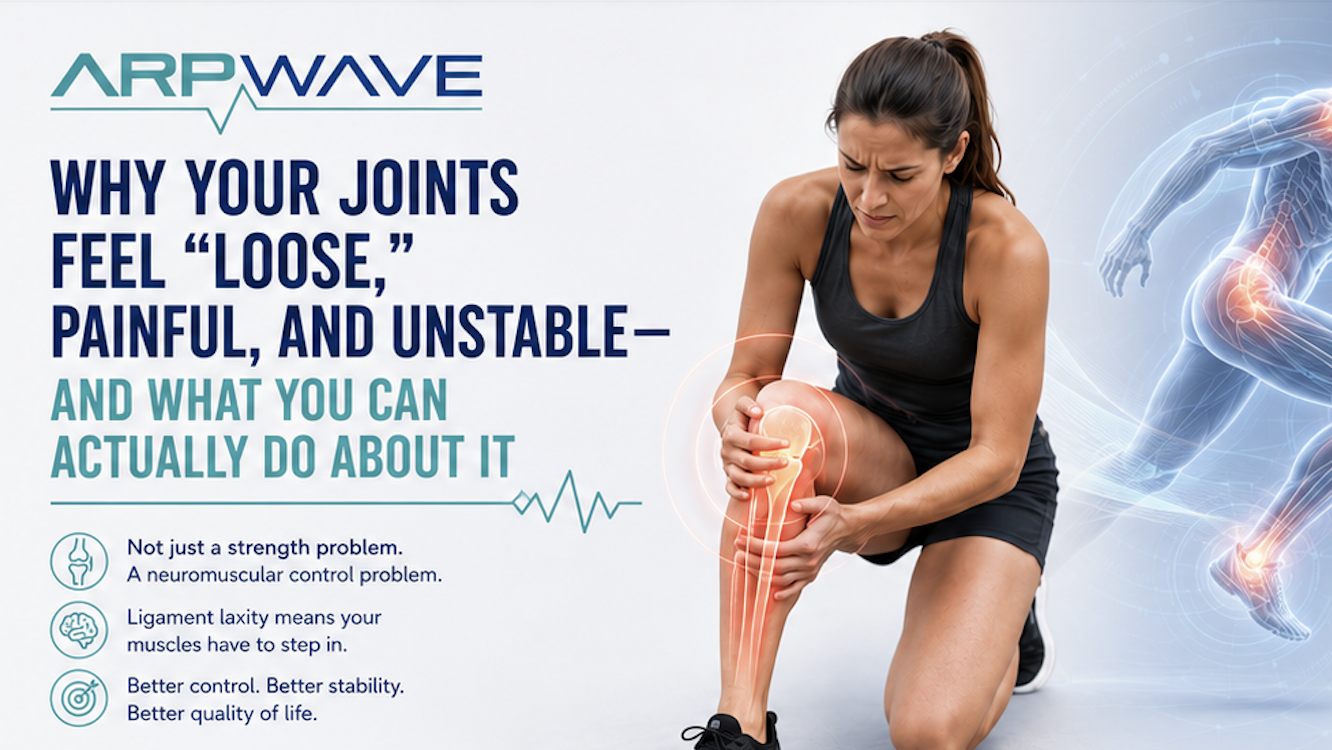
Why Your Joints Feel “Loose,” Painful, and Unstable — And What You Can Actually Do About It
If you’ve been told you have Ehlers-Danlos Syndrome (EDS) or “joint hypermobility,” you already know the frustration:
• Your joints move too much but still feel stiff and painful
• You deal with flare-ups, instability, or subluxations
• Traditional physical therapy helps, but progress is slow or inconsistent
• You may have been told you simply need to “get stronger”
But the reality is this isn’t just a strength problem. It’s also a neuromuscular control problem.
What’s Really Causing the Pain?
Conditions like Ehlers-Danlos Syndrome and hypermobility spectrum disorders affect connective tissue, including ligaments and collagen. When ligaments cannot provide adequate support, muscles must become the body’s primary stabilizers.
In many hypermobile patients, the nervous system struggles to coordinate muscle activation efficiently. This can lead to instability, altered movement patterns, chronic pain, fatigue, and repeated injuries.
Why Traditional Therapy Sometimes Falls Short
Many traditional approaches focus on passive therapies or generalized strengthening. While these interventions can help temporarily, they may not fully address the underlying neuromuscular coordination deficits that contribute to instability.
Patients with hypermobility often need improved motor control, proprioception, and muscle timing, not just stronger muscles.
 How ARPwave NeuroTherapy Works
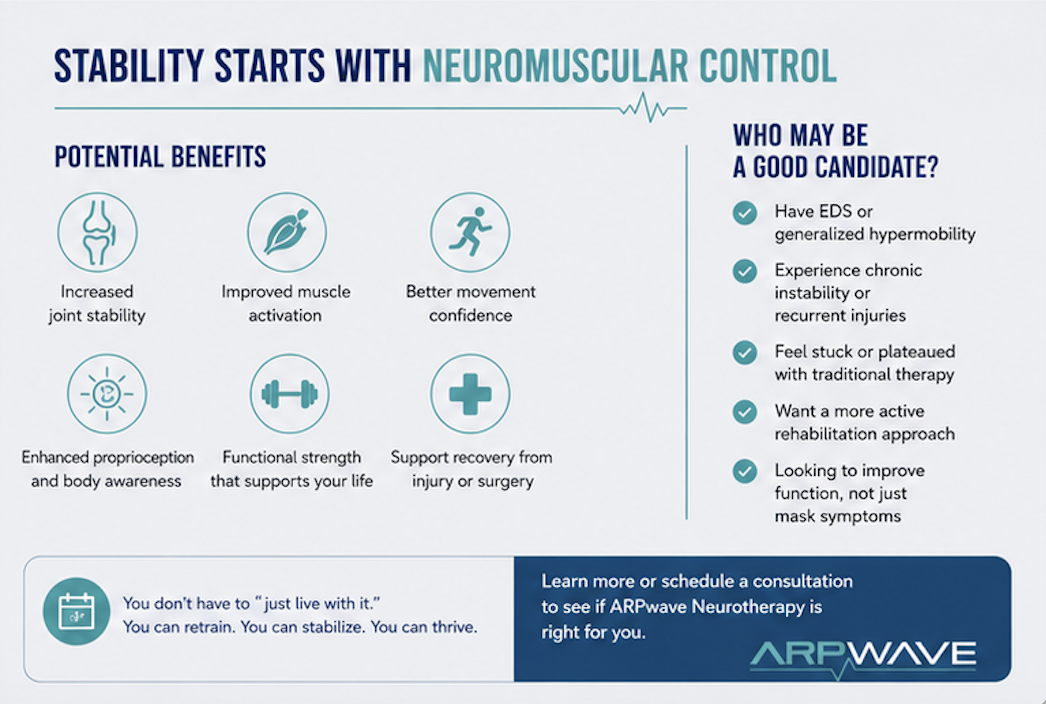 How ARPwave NeuroTherapy Works
ARPwave NeuroTherapy is a form of neuromuscular electrical stimulation (NMES) that combines electrical stimulation with active movement.
The goal is to:
• Improve muscle recruitment
• Enhance neuromuscular coordination
• Improve joint stability
• Reduce dysfunctional compensation patterns
• Reinforce proper movement mechanics
Unlike passive treatments, ARPwave is designed to help retrain the nervous system during movement.
Potential Benefits for Hypermobile Patients
Patients with EDS and hypermobility may benefit from improved:
• Joint stability
• Muscle activation
• Movement confidence
• Functional strength
• Proprioception and body awareness
• Recovery after injury or surgery
Common treatment areas may include the shoulders, knees, spine, hips, and ankles.
Why Neuromuscular Control Matters
Research suggests that improving neuromuscular control and sensorimotor function can help improve joint stability and reduce pain in hypermobile individuals.
The body relies heavily on coordinated muscle contractions to compensate for ligament laxity. Improving communication between the brain and muscles may help patients move more efficiently and with less discomfort.
Who May Be a Good Candidate?
ARPwave NeuroTherapy may be appropriate for people who:
• Have EDS or generalized hypermobility
• Experience chronic instability or recurrent injuries
• Feel stuck or plateaued with traditional therapy
• Want a more active rehabilitation approach
• Are looking to improve function, not just temporarily mask symptoms
Next Steps
If you are struggling with chronic instability, pain, or hypermobility-related dysfunction, ARPwave NeuroTherapy may provide a different approach focused on neuromuscular retraining and functional stability.
Schedule a consultation or trial session to learn whether this approach may be appropriate for your condition.
References
Malfait F, Francomano C, Byers P, et al. The 2017 international classification of the Ehlers-Danlos syndromes. American Journal of Medical Genetics Part C. 2017.
Engelbert RHH, Juul-Kristensen B, Pacey V, et al. The evidence-based rationale for physical therapy treatment of children, adolescents, and adults diagnosed with joint hypermobility syndrome/hypermobile Ehlers Danlos syndrome. American Journal of Medical Genetics Part C. 2017.
Russek LN, Stott P, Simmonds JV. Recognizing and effectively managing hypermobility-related conditions. Physical Therapy. 2021.
Smith TO, Easton V, Bacon H, et al. The relationship between benign joint hypermobility syndrome and psychological distress: A systematic review and meta-analysis. Rheumatology. 2014.
Lake DA. Neuromuscular electrical stimulation: An overview and its application in the treatment of sports injuries. Sports Medicine. 1992.
Maffiuletti NA. Physiological and methodological considerations for the use of neuromuscular electrical stimulation. European Journal of Applied Physiology. 2010.
The Ehlers-Danlos Society. Exercise and movement for adults with hypermobile EDS and hypermobility spectrum disorders.