
ARPwave Resources
Muscle Atrophy After Surgery | ARPwave NeuroTherapy

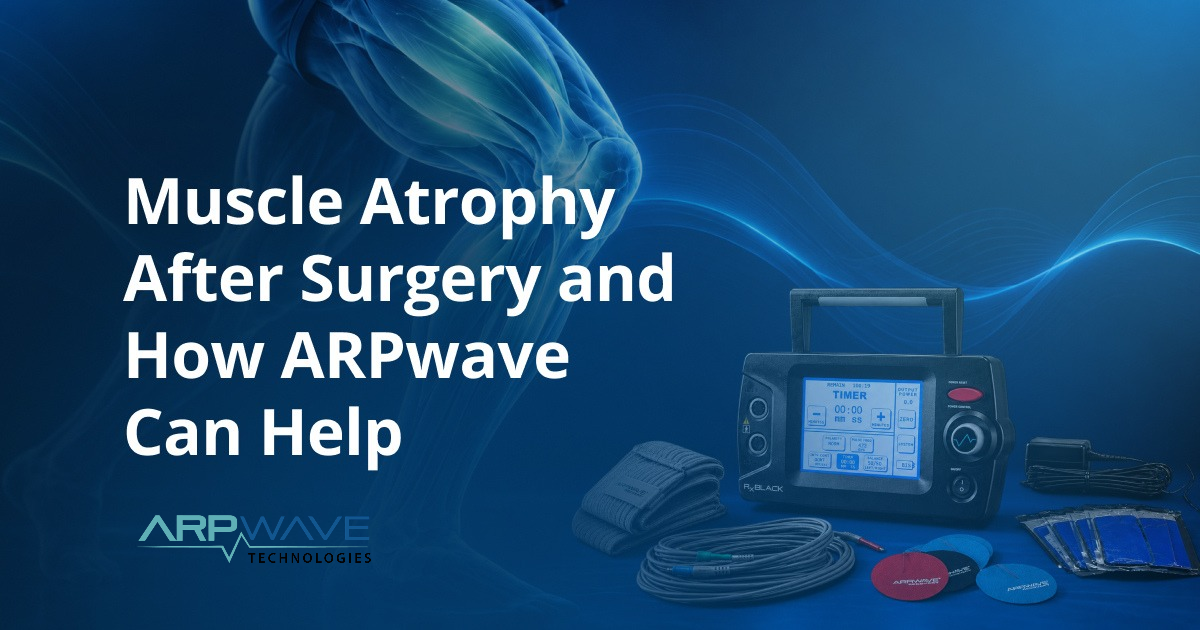
Muscle Atrophy After Surgery and How ARPwave Can Help
What happens to your muscles during immobilization
After surgery, wearing a brace, using crutches, or limiting movement may be necessary to protect healing tissues. While the surgical site recovers, your muscles are also adapting to a substantial change in how they are used.
Reduced activity can lead to disuse atrophy, or a decrease in muscle size. Strength, muscle activation, and movement control can change, too. That is why a recovery plan should account for the muscles that will eventually help you walk, lift, work, or return to sport.
Understanding these changes creates an opportunity to address them. With the right medical guidance, rehabilitation can include strategies to limit muscle loss and rebuild function. ARPwave NeuroTherapy can be considered as part of that plan. For a broader look at the process, read our post-surgery recovery overview. 9
What is disuse atrophy
Muscles adapt to the demands placed on them. Walking, climbing stairs, lifting, and exercising all give muscles a reason to maintain their capacity. Immobilization reduces that demand.
Disuse atrophy is the loss of muscle size that occurs when a muscle is used less than usual. After a knee procedure, you may notice a smaller thigh on the surgical side. After shoulder surgery, changes may become noticeable around the shoulder or upper arm. The extent of loss varies with the duration of inactivity, the procedure, and the individual’s health.
How quickly can muscle loss begin
Muscle loss can become measurable within days. In a controlled study of healthy young men, five days of leg immobilization reduced quadriceps size and strength in participants who did not receive neuromuscular electrical stimulation. That study does not predict an exact rate of loss for every surgical patient, but it shows why even a short period of restricted activity deserves attention. 1
Discussing muscle preservation before surgery, or early in recovery, gives your healthcare team the opportunity to identify what is appropriate at each stage. The plan should work within the restrictions needed to protect your repair. Our guide to preparing for surgery explores planning ahead with ARPwave. 10
Why weakness is about more than muscle size
A muscle can be weak because it has lost size, because it is harder to activate effectively, or both. Research involving the knee shows that pain and joint swelling can reduce quadriceps activation and strength. This helps explain why a muscle may feel difficult to contract even when you are trying hard to use it. 2
For someone recovering from knee surgery, that may show up as difficulty engaging the thigh or controlling the leg. As activity resumes, rehabilitation may need to address how muscles participate in movement as well as how much force they can produce. ARPwave also discusses quadriceps recovery after ACL surgery in a procedure-specific article. 14
Can disuse atrophy be avoided
A recovery plan can help limit disuse atrophy. Whether it can be fully prevented depends on the procedure, the restrictions, and the individual.
In the five-day immobilization study, supervised neuromuscular electrical stimulation prevented measurable quadriceps muscle loss in the stimulation group. Strength still declined. Preserving muscle size therefore did not preserve every aspect of muscle function. These findings came from healthy volunteers and support a role for stimulation under specific conditions; they do not guarantee the same result after every surgery. Additional NMES studies are collected on our clinical research and reference page. 1,12
The practical goal is to preserve as much capacity as possible while the surgical site heals, then progressively rebuild strength and useful movement.
What helps reduce muscle loss during recovery
The most useful plan starts with your surgical team and accounts for what you are allowed to do. Depending on the procedure and stage of healing, it may include the following.
- Approved muscle activation and movement. Some patients can begin selected exercises while other movements remain restricted. Your surgeon or physical therapist should determine which contractions, movements, and loads are appropriate. 3
- Nutrition that supports recovery. A balanced diet with adequate protein helps support recovery. Eating less simply because you are less active can leave important nutritional needs unmet. Discuss those needs with your healthcare team, especially if your appetite or usual food intake has changed. 4
- Neuromuscular electrical stimulation when appropriate. NMES uses electrical impulses to produce muscle contractions. A randomized trial after total knee replacement found that adding early NMES to rehabilitation improved quadriceps strength and functional performance. This was research on NMES, not an ARPwave-specific trial. For a patient-focused overview, see our knee replacement recovery guide. 5,11
- Progressive exercise. As healing permits, increasing exercise demands helps rebuild strength and mobility. Progression should follow your procedure and your healthcare team’s guidance. 3
Stimulation-induced contractions place demands on tissues, too. A brace or non-weight-bearing restriction does not automatically make every stimulation application appropriate. Timing, electrode placement, intensity, and exercise selection need to fit your surgical plan. 6
Stiffness and compensation also deserve attention
Reduced movement can leave you feeling stiff, while a brace, sling, or crutches may change how you handle everyday tasks. You may rely more on the opposite limb or shift your weight to make an activity easier.
Those adjustments can help you get through the protected phase of recovery. As restrictions lift, your rehabilitation team can assess mobility and movement control alongside strength. For example, returning to a squat involves more than completing the repetition; it also involves how you distribute weight and control the movement.
How ARPwave can assist after surgery
ARPwave NeuroTherapy combines neuromuscular electrical stimulation with individualized electrode placement, structured protocols, and movement when appropriate. The approach gives patients and providers a way to incorporate muscle activation into a progressive rehabilitation program. 7
ARPwave’s prescription Rx100 and RxBlack devices have indications that include prevention or retardation of disuse atrophy, muscle re-education, and maintaining or increasing range of motion. These indications are directly relevant to several challenges that can arise during restricted activity. 6,7,15
Published results from an ARP rehabilitation study
A 2019 study followed 25 people with thigh atrophy after ACL reconstruction. After completing 15 weeks of standard postoperative physical therapy, participants received 16 rehabilitation sessions over two months. The ARP-assisted group showed larger average gains in thigh circumference at all four measurement sites than the isometric rehabilitation group. 13
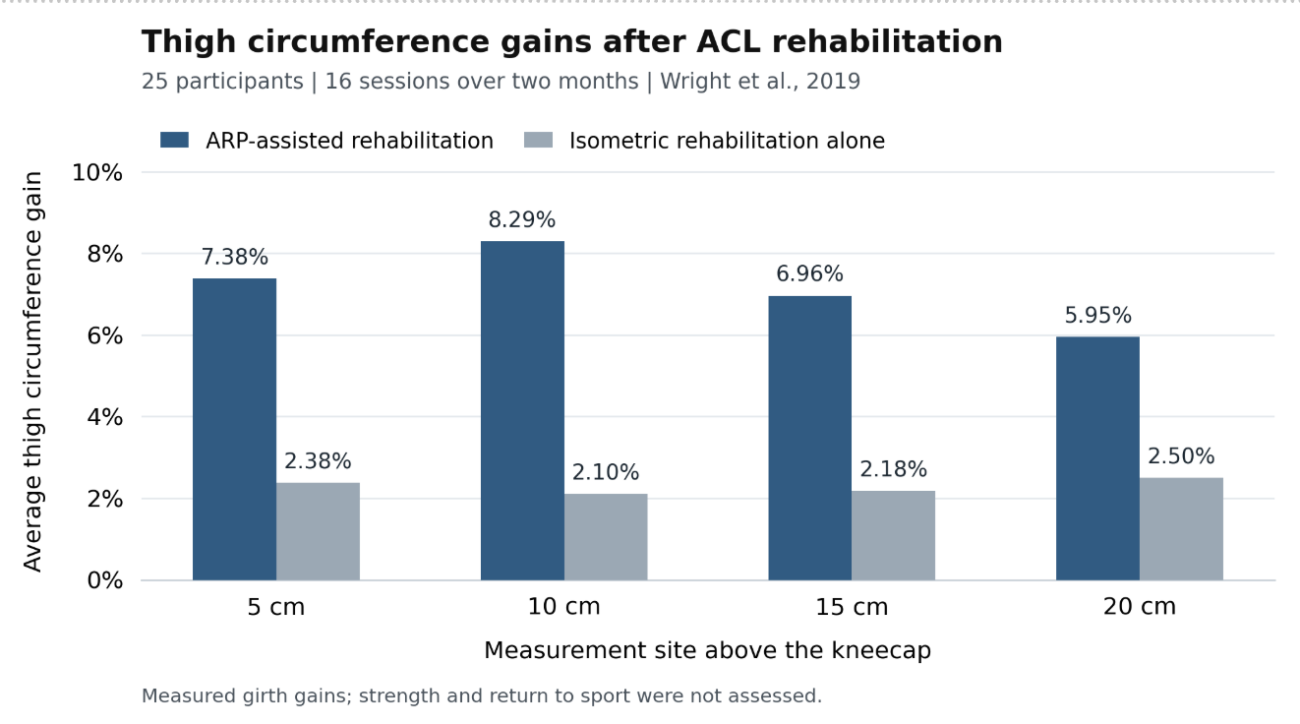
Average percentage gain in thigh circumference after the study program. Measurements were taken 5, 10, 15, and 20 cm above the upper edge of the kneecap. Source: Wright et al. (2019), Figure 3. Read the study
Thigh circumference includes more than muscle tissue. This small, unblinded study did not measure strength or return to sport, so the findings apply to measured girth gains. It studied recovery after atrophy had developed, rather than preventing atrophy immediately after surgery. Read ARPwave’s ACL recovery article for context or review the published study. 13,14
With the appropriate medical guidance, ARPwave can be incorporated into a plan focused on muscle preservation and re-education, then paired with permitted movement and exercise as recovery progresses. Its role should match the patient’s condition, healing stage, and goals. 7
ARPwave offers provider-based care and in-home options with guidance. For someone whose mobility is limited after surgery, access to an appropriate program at home may make it easier to follow the recommended schedule. Compare the available options in our guide to device rentals and in-home versus in-office care. 7,8
Post-surgical use should be cleared by your surgeon and coordinated with your rehabilitation team. Device instructions, contraindications, and surgical restrictions still apply. 6
Healing and readiness are different milestones
A healing incision does not tell you how much strength, mobility, or endurance has returned. Being cleared to increase activity is a step in the process; the demands of your everyday life or sport still need to guide your progression.
Walking around the house, working a physically demanding job, and competing in a sport require different levels of capacity. Recovery should prepare you for the activities you want to return to, with progress assessed through function as well as symptoms.
Common questions about muscle atrophy after surgery
Can I lose muscle even if I was strong before surgery?
Yes. Healthy young adults can lose muscle during immobilization. Previous fitness does not eliminate the effects of reduced use. 1
Can I use electrical stimulation while I am non-weight-bearing?
It may be appropriate in some cases, but it requires approval for your specific procedure. Muscle contractions can place stress on healing tissues even without standing or walking. 6
Does electrical stimulation replace strengthening exercises?
NMES may support rehabilitation, but rebuilding function still requires an appropriate progression of movement and exercise as healing allows. 3,5
Continue reading with ARPwave
- Post-surgery recovery overview. How ARPwave approaches recovery after surgery.
- Knee replacement recovery guide. Recovery stages, movement, and options for care at home.
- Device rentals and care options. Choosing between guided in-home and in-office programs.
- Clinical research and reference page. Published studies and educational resources for further reading.
Give your muscles a place in your recovery plan
If surgery is ahead, ask about muscle preservation before the procedure. If you are already recovering and struggling to activate a muscle or regain strength, bring that concern into the conversation now. There may be useful steps your care team can approve during the protected phase of healing.
ARPwave brings together prescription neuromuscular stimulation, structured NeuroTherapy protocols, and professional guidance to help address muscle preservation and re-education. Our team can help you explore provider-based care or an appropriate in-home program that fits your recovery needs. 8
Whether your next milestone is walking confidently, returning to work, or getting back to competition, make muscle function part of the plan. Connect with ARPwave and find out how NeuroTherapy can support the work of rebuilding your strength.
Ready to take the next step in your recovery? Contact ARPwave to discuss your surgery, restrictions, and goals, and explore the right support for your return to activity.
Sources
- Dirks ML et al. Neuromuscular electrical stimulation prevents muscle disuse atrophy during leg immobilization in humans. Acta Physiologica. 2014;210:628-641. Study of 24 healthy young men. Source
- Palmieri-Smith RM et al. Pain and effusion and quadriceps activation and strength. Journal of Athletic Training. 2013;48:186-191. Source
- American Academy of Orthopaedic Surgeons. Total Knee Replacement Exercise Guide. Source
- American Academy of Orthopaedic Surgeons. Preparing for Orthopaedic Surgery Health Condition Checklist. Source
- Stevens-Lapsley JE et al. Early neuromuscular electrical stimulation to improve quadriceps muscle strength after total knee arthroplasty. Physical Therapy. 2012;92:210-226. Source
- US Food and Drug Administration. ARP Rx100 510(k) K093259 indications for use; ARP Manufacturing Rx100 Black Operations Manual. Source | Device manual
- ARPwave. Guidance on prescription devices, NeuroTherapy protocols, rentals, and care options. Source
- ARPwave. Experience ARPwave. Provider and in-home options. Source
- ARPwave. Post-Surgery Recovery and the Role of ARPwave Therapy. Source
- ARPwave. Pre-Surgery Prep and How ARPwave Can Help A Comprehensive Guide. Source
- ARPwave. Knee replacement guidance on recovery time, pain management, and in-home options. Source
- ARPwave. Resources including clinical research, articles, and downloadable educational content. Source
- Wright AR et al. Effectiveness of Accelerated Recovery Performance for Post-ACL Reconstruction Rehabilitation. Hawaii Journal of Health and Social Welfare. 2019;78(11 Suppl 2):41-46. Figure 3 supplies the chart data. Source
- ARPwave. Enhancing Recovery After ACL Surgery The Role of Accelerated Recovery and Performance. Source
- ARPwave. RxBlack device information and access options. Source