
ARPwave Resources
The History of ARPwave: The Original Direct Current NeuroTherapy System

Today, electrical-stimulation companies frequently speak about neuromuscular activation, neurological mapping, active movement, accelerated recovery, and improved performance. Many systems claim to do what ARPwave has spent decades developing and proving in real-world application. Some have even adopted similar terminology, electrode-placement strategies, treatment concepts, and device-plus-protocol business models. But the history did not begin with today’s marketplace…
What is Direct Current NeuroTherapy
Direct current NeuroTherapy, as practiced by ARPwave, is an application system that uses electrical stimulation alongside movement and practitioner assessment. Mapping, body positioning, stimulation settings, and the participant’s response help guide the session. ARPwave presents its approach as a way to address neuromuscular function and movement patterns as part of rehabilitation and performance care. [5-6, 18]
DC means direct current. ARPwave’s historical devices also incorporate a higher-frequency background component and an adjustable main pulse; the waveform and settings differ by model. Direct current identifies an electrical characteristic, while NeuroTherapy describes how ARPwave combines the device with its application methods. [1, 3, 15-18]
The Founder and Inventors Behind the Original ARPwave System
Long before ARPwave had a name, a clinic, or a training system, its story began with a hospital pharmacist watching electrical signals move across a screen.
The year was 1983. Gary Thomas had worked as a hospital pharmacist for a decade, but he was also experimenting with a self-made electromyography machine. He used it on his own body to observe the electrical activity produced by muscle. In those patterns, Thomas believed he saw the outline of an idea: if a weak muscle had a recognizable electrical signature, perhaps a device could reproduce something like it and deliver that signal back into the body. [1]
Six years later, the story moved from memory into the public record. On May 22, 1989, Thomas filed a patent for an electrotherapeutic treatment. That same day, Thomas and Michael W. Fellinger filed a related apparatus patent. On May 25, 1989, FDA received PhysioDynamics’ 510(k) submission for a device called TheraStim. FDA cleared it on November 6, 1989. Those records created the first independently dated trail behind the technology that would eventually become ARPwave. [2-4]
But a device was only the beginning. The decisive turn came in 1990 when the technology reached Denis Thompson. Denis was interested in more than what the machine could deliver to a person lying still. He wanted to know what could happen if that person moved. That shift from signal to participation, from passive stimulation to active application became the organizing idea behind the ARP system. [2, 5-6]
ARPwave was built in stages. Gary Thomas created the electrical foundation. Denis Thompson turned the device into an active system and built a company around it. Jay Schroeder helped push its methods into elite performance. Colt Thompson joined in 2004 and now leads its modern chapter. That progression, not a single moment of invention, is what makes the story worth telling.
The TheraStim Waveform and the Roots of ARPwave
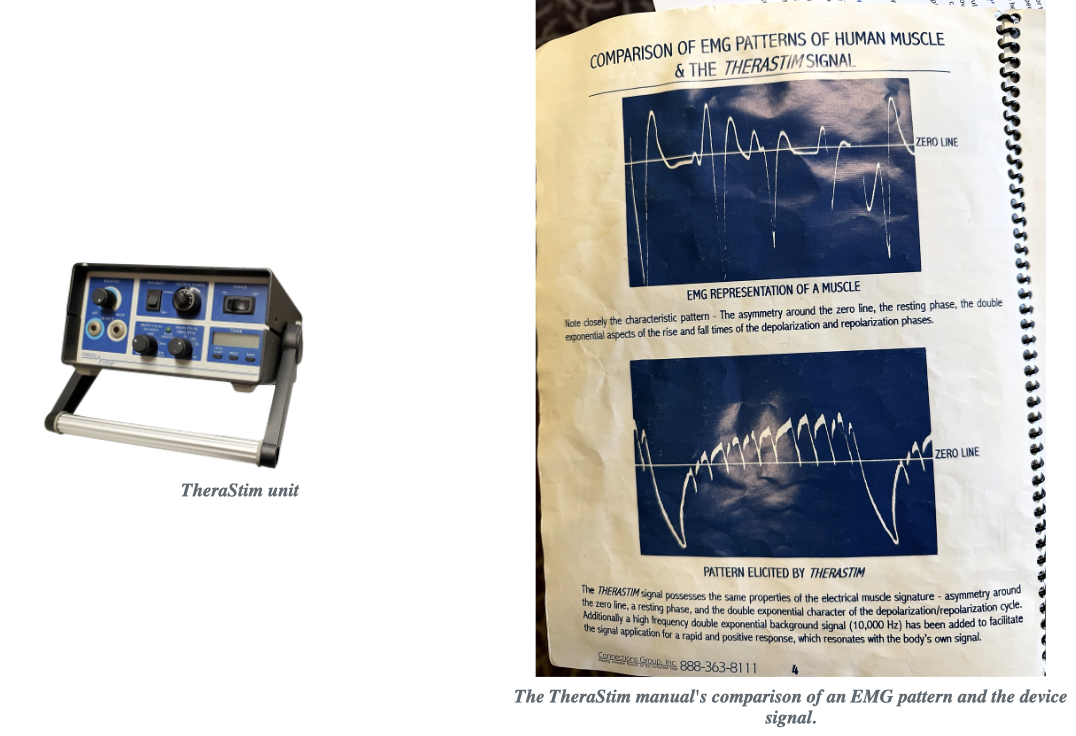
To further understand ARPwave, it helps to return to the original machine. The TheraStim manual describes Thomas’s signal as a compound, double-exponential, asymmetric waveform. It lists a main frequency of 40 to 500 pulses per second, a 10,000-pulse-per-second background frequency, and language describing directional or reversible current. Later patents and FDA records provide independently dated support for that early account. Together, they show a recognizable technical ancestor of later ARP devices: a higher-frequency element around 10 kHz combined with an adjustable lower-frequency pulse. [1, 3-4]
 Archival TheraStim manual excerpt preserving the company’s account of the technology’s 1983 origin
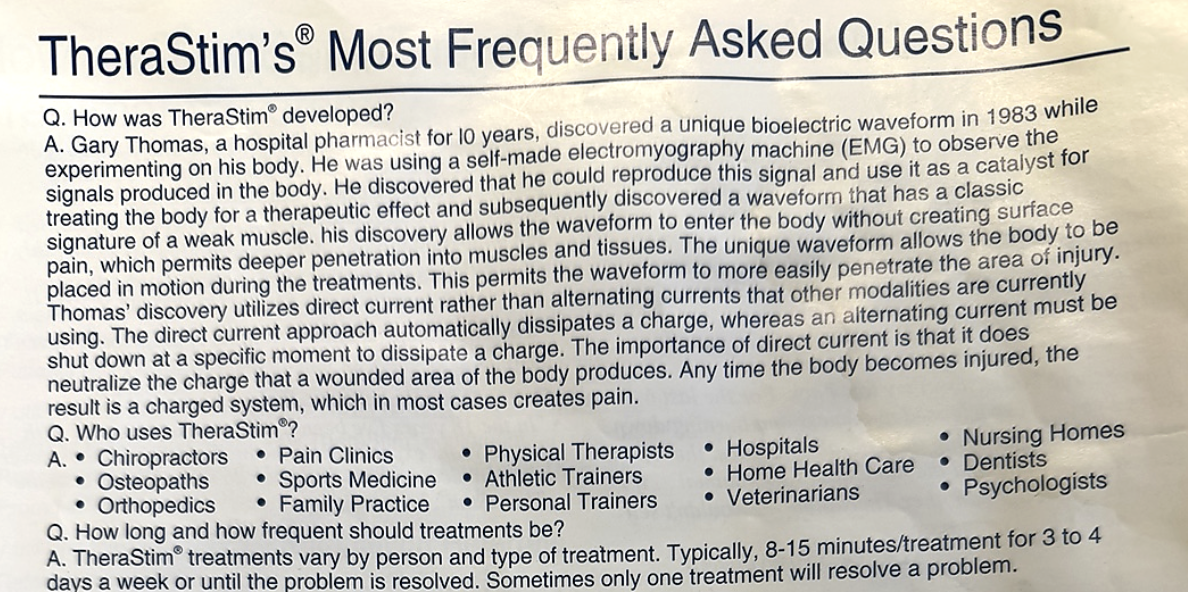
The manual also places Thomas’s idea in the scientific landscape of its time. It refers to Björn Nordenström’s theories of biologically closed electrical circuits, Robert Becker’s work on bioelectricity, Yakov Kots and so-called Russian stimulation, and theories involving collagen, scar tissue, and bradykinin. These references explain the conceptual world in which TheraStim was presented. They should not be mistaken for direct proof that every proposed mechanism was established for the device itself. [1]
One of the manual’s most revealing pages places an EMG trace above a TheraStim trace and argues that both share an asymmetric, double-exponential character. Historically, the comparison shows what Thomas believed he was reproducing.
By 1987, PhysioDynamics had been incorporated in Colorado to manufacture TheraStim. The record became much firmer in 1989 with the patent filings and FDA submission, followed by the patent grants on April 28 and May 5, 1992. At that point, TheraStim was no longer merely a remembered experiment. It was a named device with an engineering and regulatory identity. [2-4]
What it did not yet have was the system that would make it ARP.
Denis Thompson and the Development of ARPwave NeuroTherapy
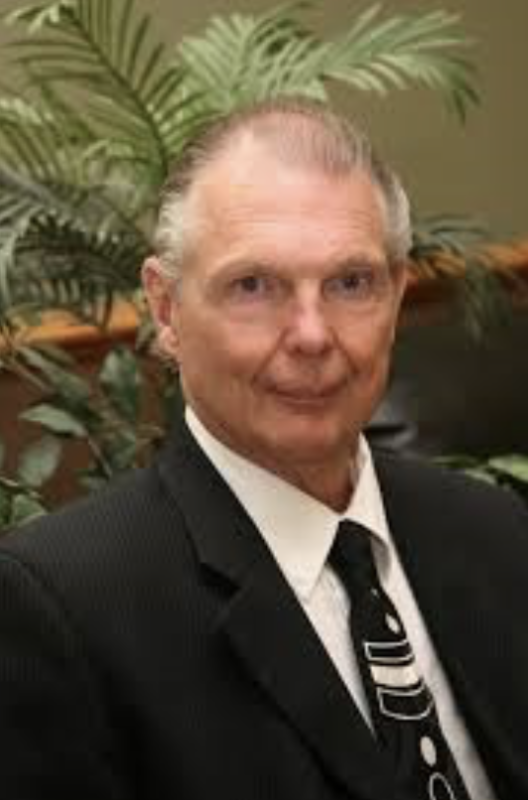
Denis Thompson, founder of ARPwave | Company History
According to company historical accounts, Gary Thomas was introduced to Denis Thompson in 1990.
Denis saw more than a machine. He saw a different way to use it. Conventional electrical stimulation could be administered to a passive patient. Denis built his approach around an active participant. The person moved. The practitioner watched. Mapping, electrode placement, body position, resistance, water-submersion techniques, and the response to a specific movement became part of the process, along with treatment of what the system identified as areas of cellular disruption.
That change in application eventually produced a vocabulary of its own: “mapping,” “Search and Destroy,” “neuro-loosening,” “In-Balance,” and “Neuro-Therapy.” The terms shifted over time, but the core idea held. The current was not meant to stand alone; it was paired with assessment, movement, recovery, and later strength work. [5-6, 13]
The 190-page ARP Trainer Training Guide, preserved in a PDF created in 2005, reveals how much knowledge had grown around the device. It covers machine controls, reversible polarity, electrode placement, protocols organized by body region, and a separate series of muscle-loosening applications. [6]
Much of ARPwave’s early history lived in practice before it appeared in publishing. The system was carried from inventor to founder, from founder to practitioner, and from session to session. By the time the manuals caught up, the method had already begun another transformation.
Jay Schroeder and the Evolution of Performance Training
In the late 1990s, Denis’s movement-centered approach met Jay Schroeder’s performance world. The collaboration began in 1998, followed by development of strengthening protocols in 1999. [2]
Jay brought his own philosophy: high-intensity, highly specific work aimed at changing what an athlete could produce. His EvoSport lineage was separate from ARPwave, but the overlap created an important branch of ARP development. Electrical stimulation was no longer being discussed only in the language of pain, recovery, or injured tissue. It was being paired with demanding movement and force production.
In 2003, participants on a public training forum were discussing Jay’s EvoSport method and a Minneapolis counterpart using ARP. On September 9, 2004, ESPN profiled Jay’s unconventional work with NFL player Adam Archuleta and depicted electrical-stimulation equipment inside the training environment. The methods were attracting attention well beyond a treatment room. [7-8]
Video: Freak of Training featuring Adam Archuleta and Jay Schroeder. | Watch on YouTube
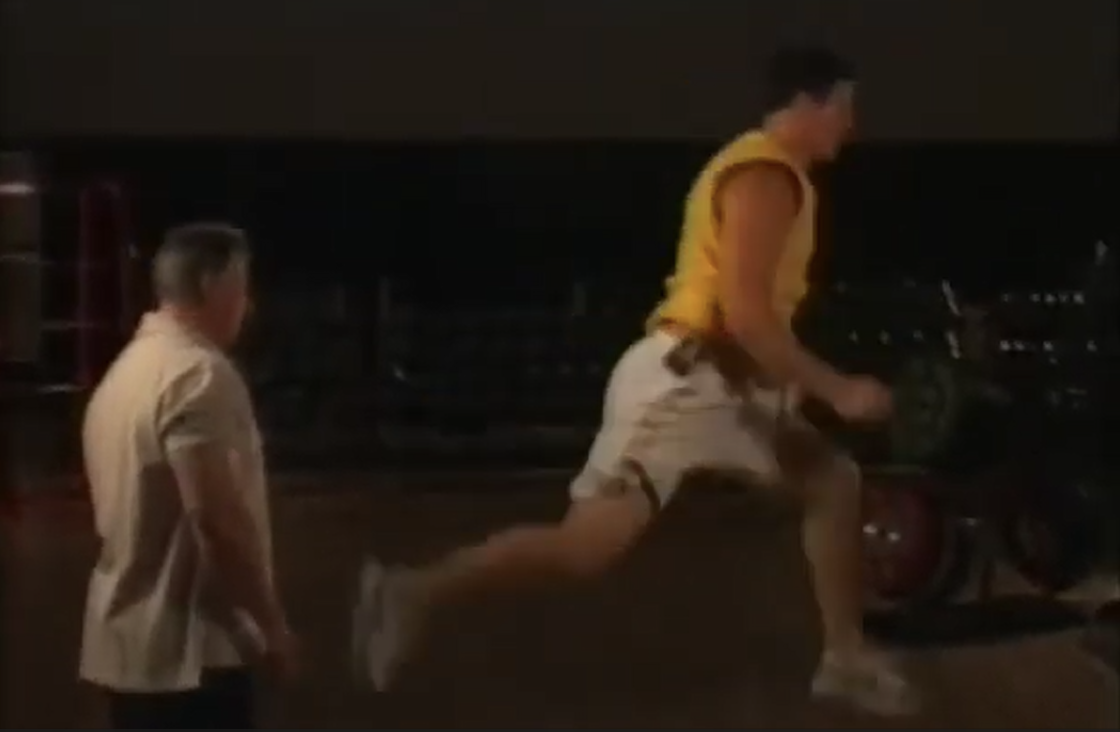 Video: Freak of Training featuring Adam Archuleta and Jay Schroeder. |
 Jay’s role extended beyond publicity. Later patents name Franklin W. Schroeder Jr. with Denis on methods involving movement, electrode placement, “facilitator” and “receiver” muscles, and force-related training. A later stimulator patent names Gary Thomas, Denis Thompson, Franklin Williard Schroeder Jr., and Donald Demma. The patent record supports a genuine co-development role. [13]
Jay Schroeder discusses the EVO System with professional baseball players. | Watch on YouTube
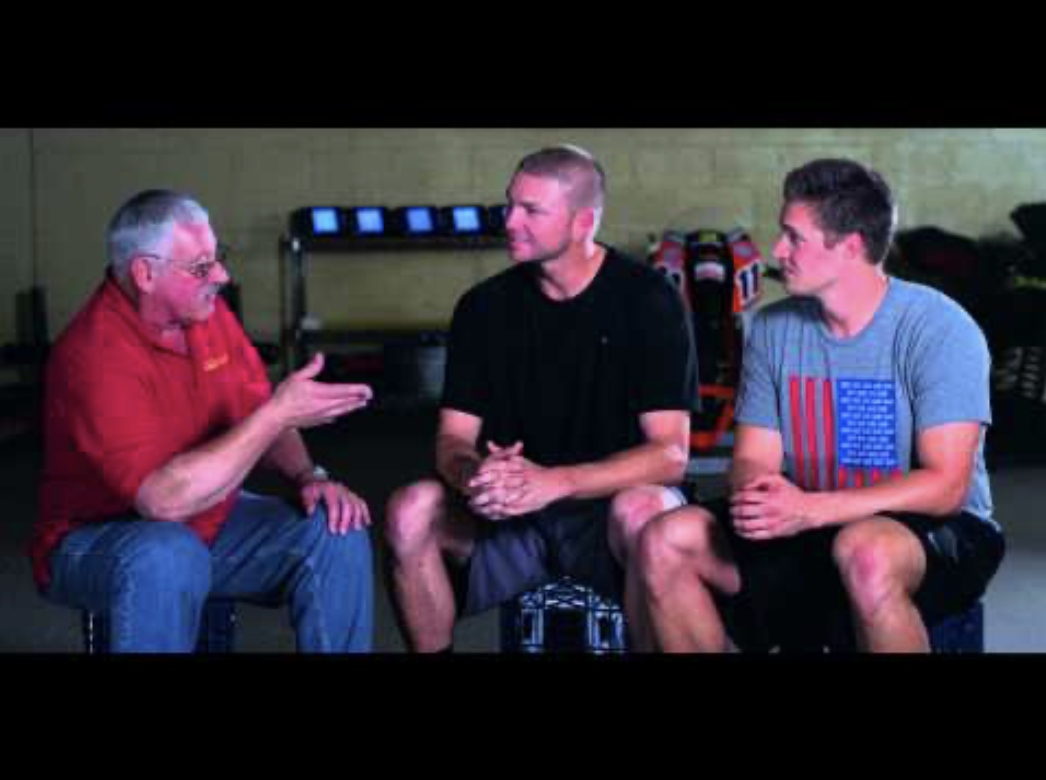 Jay Schroeder discusses the EVO System with professional baseball players. |
 The names also evolved. Public references use EvoSport by 2002 and 2003, EvoSport Ultra Fit in 2009, and EVO UltraFit by 2013. [7-8, 25]
The ARPtrainer and the ARPwave Company Timeline
While the performance work expanded, Denis was giving the system a commercial form. He introduced the A.R.P. Trainer in 2001, with the initials standing for Accelerated Recovery Performance. The name reflected the system’s two goals: recovery and performance. [2]
In 2004, the first ARP clinic opened in Burnsville, Minnesota. That same year, Colt Thompson joined the company. This marked a turning point. ARP was expanding beyond an electrical device and a set of techniques passed among a small group. It was becoming a business model built around hardware, provider education, assessment, protocols, consultation, and ongoing support. [2, 24]
The ARP name entered an independent public record on May 10, 2007, when Denis filed the ARP WAVE service mark for physical-fitness conditioning, consultation, and instruction. Public accounts from 2007 also linked Denis, Jay, EvoSport, and the ARP program. Company histories place the end of TheraStim production in 2006 and ARP Manufacturing’s acquisition of PhysioDynamics in 2007. [2, 9-10]
By then, the original waveform had accumulated a new identity. TheraStim was the ancestor. ARP was the system growing around it. The next step would make that lineage explicit in federal records.
From an Innovation to an Industry
ARPwave was never developed in isolation. According to company records, the system has now been used in the treatment of more than 600,000 patients worldwide. Thousands of professional athletes have used ARPwave for recovery and performance, and more than 300 medical professionals have been trained in the technology and its application methods. [28]
Those numbers measure reach, not controlled clinical outcomes, but they reveal the scale of what ARPwave built. ARPwave combined its electrical-stimulation technology with mapping, active movement, water-submersion techniques, recovery protocols, strengthening applications, practitioner education, and ongoing support. That integrated approach helped shape a NeuroTherapy community spanning rehabilitation, recovery, and human performance.
Success also invited imitation. Today, many devices and systems claim to reproduce the effects associated with ARPwave. Some use similar terminology, pad-placement strategies, movement concepts, or a comparable device-plus-protocol model. But surface similarities do not make the underlying technologies or systems equivalent.
All Stim is Not Created Equal
Electrical-stimulation systems can differ significantly in waveform design, current delivery, pulse-frequency range, output, polarity, programming, electrode placement, treatment protocols, provider training, and regulatory indications. Producing a muscle contraction does not mean a device reproduces the ARPwave waveform, its application methods, or the complete Neuro-Therapy system.
ARPwave’s distinction is not based on one specification or marketing claim. It is the result of more than four decades of invention, patents, regulatory filings, manuals, clinical collaboration, provider training, and real-world application. Other companies may imitate individual pieces of the model, but they cannot simply copy and paste the history, knowledge, and experience that created the industry. [2, 13-14, 28]
Rx100 and POVsport FDA Clearance and Device Evolution
On December 17, 2009, FDA cleared the prescription ARP Rx100 and identified TheraStim as its predicate. Nearly twenty years after the original TheraStim clearance, the relationship between the old platform and the new product was documented in the regulatory record. [11]
The Rx100 continued the same recognizable architecture: a high-frequency background element combined with an adjustable lower-frequency main pulse. It has a main pulse frequency that ranges from 40 to 500 pulses per second, a 10 kHz background component, reversible polarity, and output up to 2.5 watts. [16]
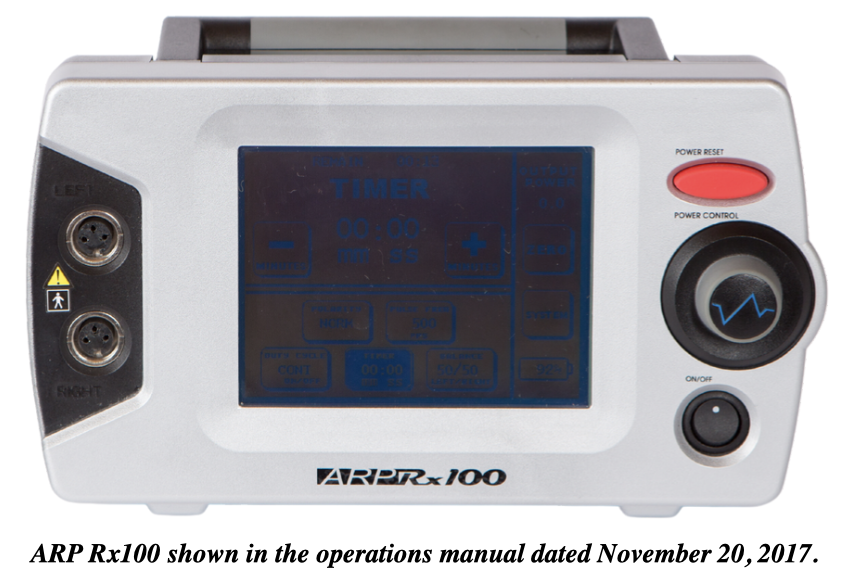
Less than eight months after the Rx100 decision, ARPwave entered a different regulatory lane. On August 10, 2010, FDA cleared POV Sport for stimulating healthy muscles to improve or facilitate muscle performance. It lists a main component of 10 to 245 pulses per second, the same 10 kHz background frequency, reversible polarity, and output up to 0.65 watts. [12, 15]
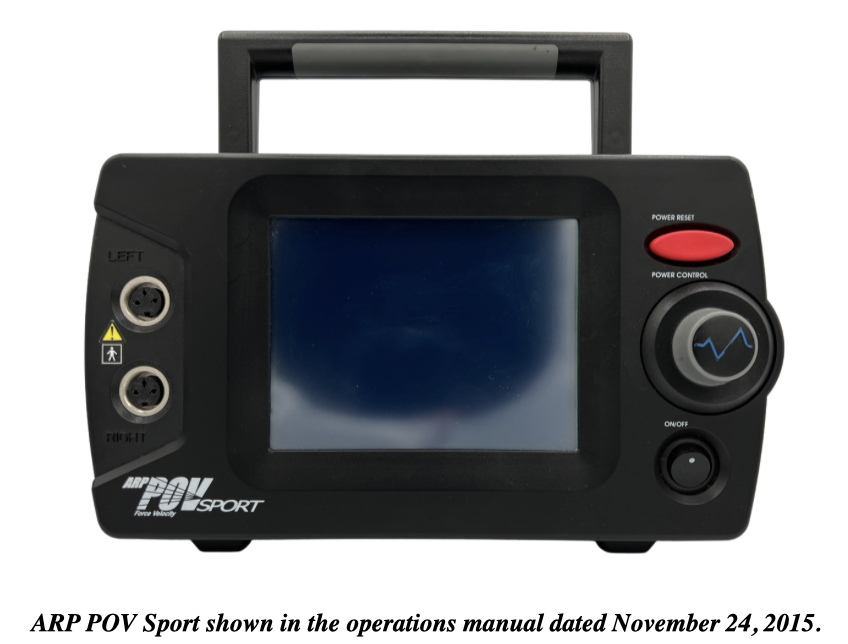
The devices themselves show both continuity and change:
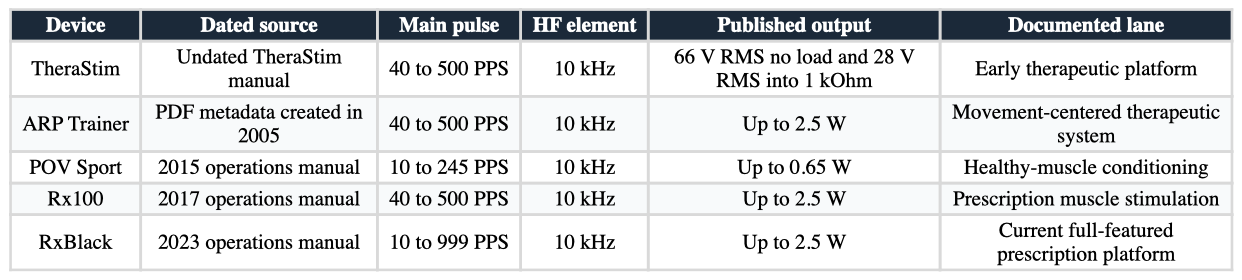
Specifications come from the cited manuals.
Colt Thompson and the Modern ARPwave Company
When Colt Thompson joined ARPwave in 2004, he entered a company that was still taking shape. He was present for the clinic era, the ARP WAVE trademark, the Rx100 and POV Sport clearances, the later patents, and the gradual shift from founder-led practice toward a more documented organization. By the time he assumed leadership in 2023, he had spent nearly two decades inside the business. [24]

Colt Thompson, president and CEO of ARPwave. | Leadership Profile
The leadership transition gave Colt responsibility for a product line, a provider network, and a body of knowledge developed across decades, some of it preserved in patents and manuals, some of it taught person to person, and some of it still waiting to be organized into a complete archive. [23-24, 28]
The pairing of a technical manual with an application guide captures the idea Denis had spent years building. The system includes the machine, along with how the device is placed, how the person moves, what the practitioner observes, and what happens next.
Current company materials position RxBlack as the full-featured prescription platform and FlexDoctor as the portable personal recovery system. [26]
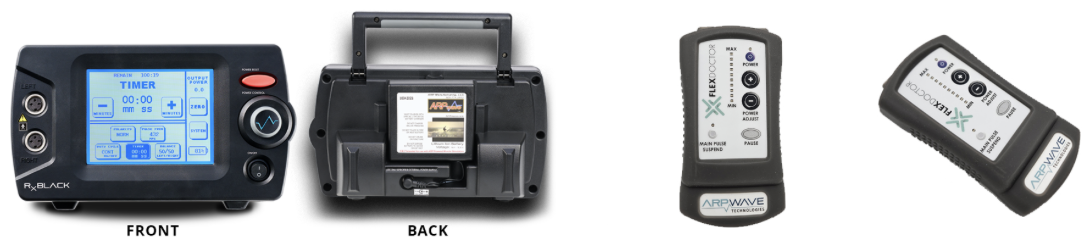
RxBlack current product image. View product
FlexDoctor current product image. View product
Colt’s chapter combines growth with stewardship: preserving the origin story, validating practitioner knowledge withscientific evidence, and deciding how a founder-built system becomes a durable modern company.
When the story meets the science – Clinical Research on ARPwave and Neuromuscular Stimulation
Every long-lived therapeutic technology eventually faces the same question: what survives when origin stories, patents, manuals, clinical experience, and controlled research are separated from one another?
The broad starting point is legitimate. Neuromuscular electrical stimulation has an established place as an adjunct in rehabilitation. Systematic reviews after ACL surgery have reported improved quadriceps strength when NMES is added to standard rehabilitation. That evidence supports the general class of intervention. It does not make every waveform, device, protocol, diagnosis, and marketing claim equivalent. [22]
A 2018 study followed 96 adults after ACL injury through a combined program of ARPwave stimulation, exercise, and a high-protein diet. The study reported increased thigh girth. [19]
A 2019 randomized study of 25 people after ACL reconstruction reported greater recovery of thigh circumference in a group receiving ARP plus isometric exercise than in a group receiving isometric exercise alone. The finding was encouraging, but the study was small and not blinded. [20]
In 2025, Dr. Raymond Butts and colleagues published a narrative review examining the rehabilitation implications of electrical modalities, including AC, DC, microcurrent, TENS, interferential current, NMES, and FES. The review provides scientific context for studying multi-waveform systems. [29]
In 2026, two chronic-stroke case studies added another exploratory signal and helped lead to a larger controlled study now underway. [27-28]
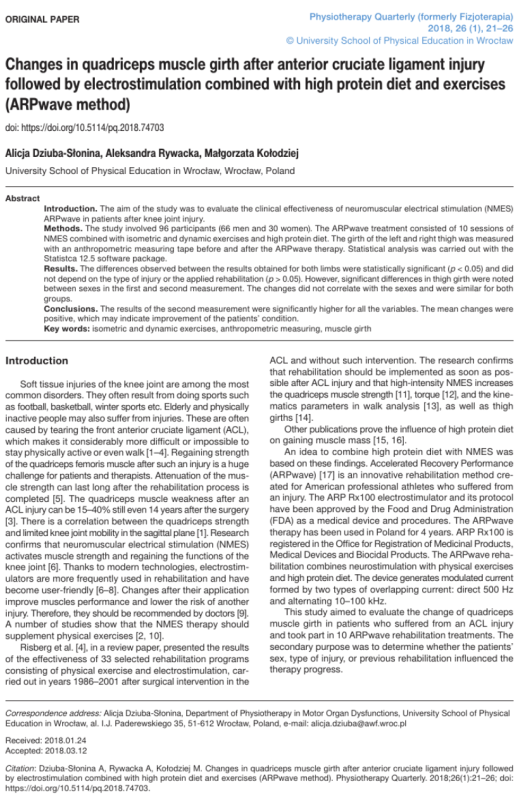
2018 Physiotherapy Quarterly article. Read article
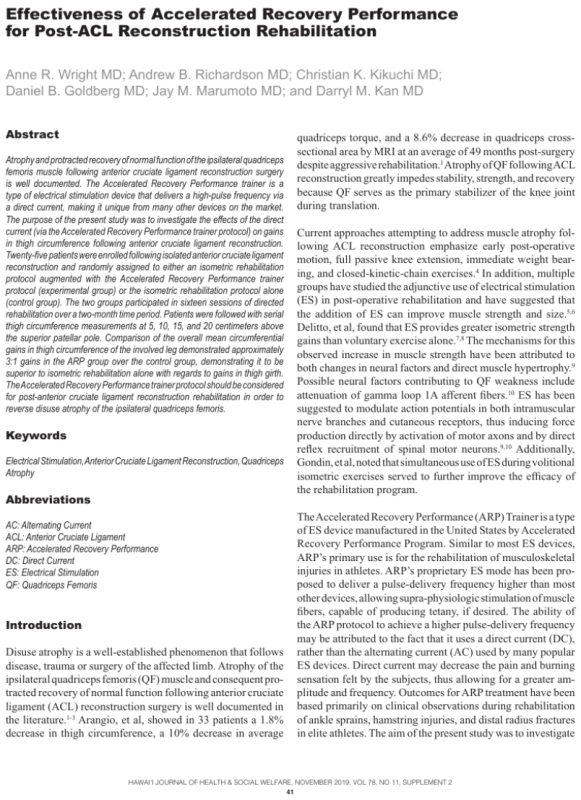
2019 post-ACL reconstruction study. Read article
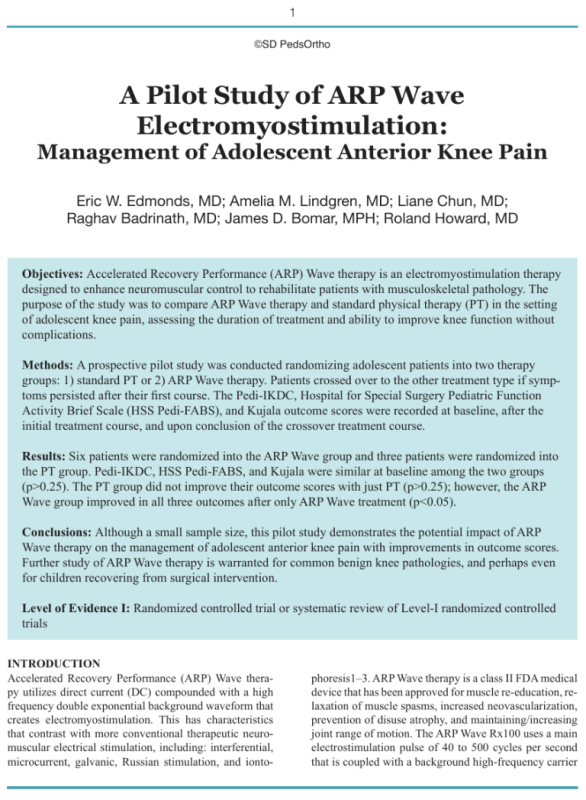
2023 pilot study of ARP Wave electromyostimulation in adolescent anterior knee pain. Read article
Historical media archive
These recordings preserve first-person explanations of the system and provide additional context for the people and methods in the timeline.
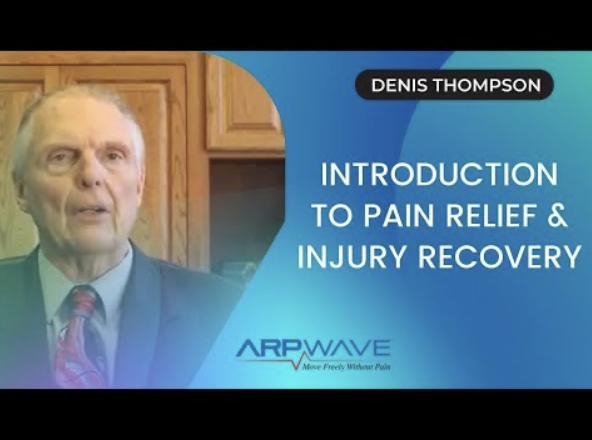
Denis Thompson introduces the ARPwave approach. Watch video
Colt Thompson with Dr. Ben England and Dr. Raymond Butts. Watch interview
Studies: Resources | ARPwave Neuromuscular Therapy
Articles: ARPwave Articles | Neuromuscular Therapy
The Future of ARPwave DC NeuroTherapy
The impact of ARPwave extends beyond its devices to the patients, practitioners, athletes, and businesses that have become part of its story. With more than 600,000 patients treated worldwide, over 300 medical practices and professionals trained, and thousands of professional athletes served, its process has helped shape a growing NeuroTherapy industry and inspired competing approaches. Others may reproduce pieces of the model, but the decades of knowledge, experience, and relationships developed by the ARPwave team cannot be copied into a product. The opportunity ahead is to build on that foundation: educate more providers, strengthen the research, and bring the process to more people. ARPwave’s history explains how it arrived here. Its next chapter invites new ideas, new partnerships, and new possibilities. Where will ARPwave go next, and how will you be part of it?
Frequently asked questions about ARPwave history
What does ARP stand for?
ARP stands for Accelerated Recovery Performance. [2]
What is direct current NeuroTherapy
In ARPwave’s approach, direct current NeuroTherapy combines electrical stimulation with assessment, electrode placement, active movement, and application protocols. DC refers to direct current. The complete ARPwave system also includes provider education and support; device specifications and intended use vary by model.
Who founded ARPwave and developed its NeuroTherapy system?
Denis Thompson founded ARPwave and developed its movement-based ARP application system. Gary Thomas created the TheraStim electrical foundation; Michael W. Fellinger co-invented its apparatus. Jay Schroeder contributed performance applications, and later stimulator patents also credit Donald Demma. Colt Thompson leads the modern company.
When did ARPwave begin?
The technology lineage begins in 1983, according to a later TheraStim manual. The independently dated record begins with patent and FDA filings in 1989. Denis introduced the ARP Trainer in 2001 according to ARPwave’s complaint, the first ARP clinic opened in 2004, and the ARP WAVE service mark was filed in 2007. [1-4, 9]
What was TheraStim?
TheraStim was a powered muscle stimulator developed through PhysioDynamics and associated with Gary Thomas. Its patented design combined a high-frequency component with an adjustable lower-frequency pulse. FDA later identified TheraStim as the predicate for the ARP Rx100. [3-4, 11]
What did Denis Thompson contribute?
Denis Thompson combined the electrical device into an application system. He combined stimulation with assessment, active movement, body positioning, electrode placement, recovery and strengthening protocols, provider education, and ongoing support. He built the ARPwave company around that integrated approach. [2, 5-6, 13]
What role did Jay Schroeder and EVO UltraFit play?
Jay Schroeder brought a separate high-intensity performance philosophy and collaborated on ARP strengthening and movement applications. Later patents list Franklin W. Schroeder Jr. with Denis Thompson on movement, placement, and training methods. EVO UltraFit remained Jay’s own training lineage rather than another name for ARPwave. [7-8, 13, 25]
Is ARPwave the original direct current NeuroTherapy system
ARPwave is the original system developed from TheraStim technology through Denis Thompson’s movement-based application methods and subsequent collaborations. Patents, manuals, and FDA records document that lineage. Its originality is grounded in that specific history of the device, methods, and company.
How do I choose the best direct current NeuroTherapy system
Compare the device’s cleared intended use, published waveform and output specifications, adjustability, clinical evidence for your intended application, and quality of provider education and ongoing support. ARPwave’s documented history, adjustable RxBlack pulse range of 10 to 999 PPS, portability (Battery or Outlet Supply), and integrated training and protocol system are relevant comparison points.
Is ARPwave FDA approved?
The precise statement is that specific devices were cleared by FDA through the 510(k) process for defined uses. TheraStim was cleared in 1989, Rx100 in 2009, and POV Sport in 2010. Those clearances are not a blanket endorsement of every ARPwave protocol, mechanism, or performance claim. [4, 11-12]
What is the difference between Rx100, POV Sport, and RxBlack?
Rx100 is a prescription muscle stimulator in the TheraStim predicate lineage. POV Sport was cleared for conditioning healthy muscles and had lower published output specifications. RxBlack is the current full-featured prescription platform; its 2023 operations manual lists an adjustable 10-to-999-pulse-per-second main component. [11-12, 15-17]
What does the science say about ARPwave?
Research supports neuromuscular electrical stimulation broadly as an adjunct to rehabilitation. Early ARPwave studies have reported changes in thigh circumference after ACL injury or reconstruction, and case studies have explored other applications. Findings should be interpreted according to each study’s population, design, and endpoints. A 2025 narrative review supplies broader scientific context for investigating multi-waveform technology.
Who leads ARPwave today?
Colt Thompson joined ARPwave in 2004 and has led the company since 2023. His chapter includes modern products, provider education, historical preservation, and the work of building stronger evidence around the system. [24]
Experience the Original ARPwave NeuroTherapy system
ARPwave is based in Apple Valley, Minnesota. Patients and athletes can request information or connect with ARPwave. Clinicians can explore provider education and practice integration, while readers can review the published research and clinical resources behind the system.
Sources and historical notes
Primary records are favored for dates, inventors, device specifications, and regulatory status. Company accounts and legal allegations are identified as such.
1. TheraStim Training Manual, undated, pages 4 to 7, Connections Group Inc. Photographs supplied 3 September 2026.
2. ARP Wave LLC and ARP Manufacturing LLC v Salpeter et al. Complaint, filed 18 July 2018. Historical allegations are attributed, not treated as judicial findings. Source
3. Gary E. Thomas, Electrotherapeutic treatment, US Patent 5,107,835, filed 22 May 1989 and granted 28 April 1992; Gary E. Thomas and Michael W. Fellinger, Electrotherapeutic apparatus, US Patent 5,109,848, filed 22 May 1989 and granted 5 May 1992. Source
4. US Food and Drug Administration, TheraStim 510(k) K893851, received 25 May 1989 and cleared 6 November 1989. Source
5. ARPwave company history and founder account. Source
6. Accelerated Recovery Performance Inc., ARP Training Guide, undated in the document. Surviving PDF metadata records creation 13 January 2005 and modification 29 November 2007.
7. Charlie Francis Training Forum, Sample Jay Schroeder Program, public discussion dated July and August 2003. Source
8. David Fleming, Trying to stay current, ESPN Page 2, 9 September 2004. Source
9. ARP WAVE trademark record, serial 77177147, filed 10 May 2007. Source
10. Arron Oberholser press conference transcript, PGA Championship, 9 August 2007. Source
11. US Food and Drug Administration, ARP Rx100 510(k) K093259, decision 17 December 2009. Source
12. US Food and Drug Administration, ARP POV Sport 510(k) K093999, decision 10 August 2010. Source
13. Later ARP patents US 8,768,474, US 9,302,102, and US 9,526,892, with priority or filing dates beginning 5 October 2009 and grants from 2014 to 2016. Source
14. ARP Wave LLC v Salpeter et al., order on cross motions for summary judgment, 19 January 2021. Source
15. ARPwave, POV SPORT Operations Manual, document 001091 Rev. D, 24 November 2015.
16. ARPwave, ARP Rx100 Operations Manual, document 001086 Rev. H, 20 November 2017; later Rev. I dated 30 July 2019. Source
17. ARPwave, RxBlack Operations Manual, Rev. III, 13 November 2023. Source
18. ARPwave, RxBlack Application Guide, revision November 2023. Source
19. Dziuba Slonina et al., Changes in quadriceps muscle girth after anterior cruciate ligament injury followed by electrostimulation combined with high protein diet and exercises, Physiotherapy Quarterly, 2018. Source
20. Wright et al., Effectiveness of Accelerated Recovery Performance for post ACL reconstruction rehabilitation, Hawaii Journal of Health and Social Welfare, 2019. Source
21. Edmonds et al., A pilot study of ARP Wave electromyostimulation in adolescent anterior knee pain, 2023. Source
22. Hauger et al., 2018, and Li et al., 2025, systematic reviews of neuromuscular electrical stimulation after ACL surgery. Source
23. Denis Thompson obituary, Minnesota Star Tribune, published 12 March 2023. Source
24. Twin Cities Business, Colt Thompson, 2025 Notable Health Care Leaders. Source
25. EVO UltraFit company history and dated public references to EvoSport and EVO UltraFit. Source
26. ARPwave current product information for RxBlack and FlexDoctor. Source
27. Georgia Southern University, targeted exercise with multiple waveform neuromuscular electrical stimulation in chronic stroke, two longitudinal case studies presented 23 April 2026. Source
28. ARPwave internal company history and leadership narrative supplied by Colt Thompson, September 2026. Includes the February 23, 2023 date of Denis Thompson’s death, use in the treatment of more than 600,000 patients worldwide, work with thousands of professional athletes, training of more than 300 medical professionals, and the larger controlled stroke study now in development.
29. Raymond Butts, Benjamin England, Nicholas J. Siekirk, Mark F. Masters, and Sean Flannagan, A narrative review of single-waveform electrical modalities (part 1): rehabilitation implications for healthcare professionals, Journal of Bodywork and Movement Therapies, published online 6 September 2025; volume 45, December 2025, pages 458-476. PubMed | Publisher/DOI