
ARPwave Resources
ARPwave for Achilles Tendinopathy: A Neuromuscular Approach to Rehabilitation

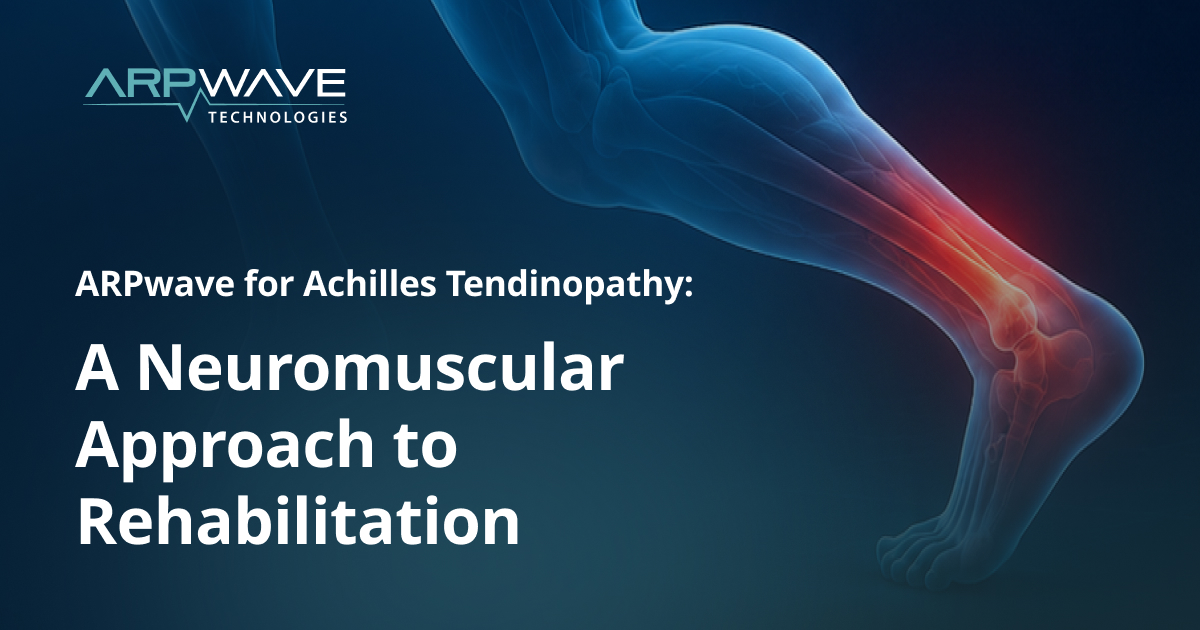
Achilles tendinopathy is persistent Achilles tendon pain and reduced function associated with loading. It can make it difficult to return to activities that place demands on the lower leg, from walking and climbing stairs to running, jumping, and athletics. Because the Achilles is involved in nearly every step we take, rehabilitation requires more than simply giving the tendon time.
The Achilles needs to regain its ability to handle force.
ARPwave NeuroTherapy addresses Achilles rehabilitation through three connected priorities: neuro efficiency, therapy, and strength and function. Neuro testing helps guide the starting point; ARPwave devices and their application guidelines then connect targeted stimulation with active movement and progressive loading. The objective is to improve how the nervous system and muscles organize movement as the individual rebuilds the capacity to manage force.
Why Is the Achilles So Challenging to Rehabilitate?
The Achilles is the largest and strongest tendon in the body. It connects the calf muscles to the heel and plays an essential role in walking, running, jumping, and pushing off the ground. It also functions like an elastic spring: as the foot contacts the ground, the tendon helps store energy, then returns that energy during push-off. Rebuilding this elastic load capacity, including tolerance for repeated loading, is an important part of restoring function.
Achilles tendinopathy often causes pain with activity, morning stiffness, and tenderness. People frequently search for “Achilles tendonitis” or “Achilles tendinitis,” but persistent tendon problems are commonly described as tendinopathy. AAOS explains Achilles symptoms and the distinction between insertional and noninsertional tendon problems.
Location matters. Midportion Achilles tendinopathy affects the tendon above its heel attachment; insertional Achilles tendinopathy affects the attachment itself. These presentations may require different exercise ranges and loading strategies. A clinical assessment helps establish which problem is present and whether another cause of heel pain needs attention.
Restoring capacity takes time, and the Achilles continues to experience load during everyday activities. This is where the ARPwave system brings an additional focus: evaluating and training the muscle function and movement strategies that accompany tendon loading. The tendon needs an appropriate mechanical stimulus, and the person needs the muscular capacity and control to perform that loading effectively.
How Can ARPwave Be Used for Achilles Tendinopathy?
ARPwave NeuroTherapy approaches Achilles rehabilitation from a neuromuscular perspective. Every movement depends on communication between the nervous system and muscles. The nervous system controls when muscles activate, how strongly they contract, and how different muscle groups coordinate to perform a task.
Following an injury or changes in activity, strength and movement strategies may also change. When certain muscles are not contributing effectively, a person may compensate to continue an activity. ARPwave begins by considering whether the muscles are responding effectively to the task, then uses the findings to guide neuro efficiency applications, therapy, and strength work.
Neuro efficiency and neuro testing
ARPwave uses the term neuro efficiency to describe how effectively the nervous system and muscles communicate to produce an appropriate response during testing and movement. The focus includes recruitment, coordination, and the ability to contribute to a task. A muscle may have the potential to produce force yet still perform inconsistently when challenged within a movement.
In the ARPwave system, provider-administered muscle tests help assess those responses before treatment. When the findings indicate a need, neuro efficiency reset applications are used and the tests are repeated to observe the response. This test, apply, and retest process helps guide the next stage of therapy. The provider can then use search or mapping procedures to individualize treatment, followed by strength and functional progression.
For Achilles rehabilitation, the practical question is whether the lower extremity muscles are contributing effectively to the movements the individual needs to recover. Neuro testing addresses the muscle response component, while calf strength, heel-rise performance, walking, and later running or jumping tests address functional capacity. Both belong in the assessment.
The 2025 narrative review by Raymond Butts and colleagues provides a scientific rationale for integrating electrical stimulation with exercise. It describes how electrical modalities can influence muscle activation, pain processing, and adaptations associated with training. Applied to the ARPwave system, that rationale connects three rehabilitation goals: engaging muscle, practicing movement, and progressively developing functional capacity.
Recruiting muscle during rehabilitation
Neuromuscular electrical stimulation can activate motor nerves and produce muscle contractions. In ARPwave rehabilitation, the provider pairs that input with selected tasks to address muscle function within movement. For the Achilles, the clinical objective may include engaging the calf and other lower extremity muscles during activities that prepare the individual for walking, push-off, and later athletic demands.
Connecting sensory input with purposeful movement
Electrical stimulation also provides sensory input to the nervous system. ARPwave applications combine that input with intentional movement and provider feedback, creating an opportunity to practice the desired task while working on muscle recruitment. This is the rationale for muscle re-education: repeated, appropriately challenged movement is part of the application, rather than an assumption that stimulation alone will teach coordination.
Addressing pain while rebuilding function
The Butts review discusses pain-modulating effects of electrical modalities as well as muscle activation. When pain limits exercise participation, symptom management may help create an opportunity for rehabilitation. ARPwave providers can use that opportunity to work toward better movement and loading tolerance. Progress still depends on the response to exercise and recovery between sessions, because reduced pain does not immediately establish greater tendon capacity.
Looking Beyond the Site of the Injury
The Achilles does not work independently. The foot, ankle, calf, knee, hip, and pelvis all contribute to movement. A previous injury, strength deficit, mobility restriction, or altered movement pattern elsewhere in the body may influence how someone walks, runs, jumps, or pushes off the ground.
This is an important part of the ARPwave approach to Achilles rehabilitation. Providers combine functional assessment with search or mapping procedures, observing how stimulation and movement responses vary across relevant areas. The findings help guide electrode placement, exercise selection, and reassessment. Search findings contribute to the application plan alongside the clinical examination; they are not a stand-alone diagnosis of tendon pathology.
For example, if a person struggles to perform a controlled heel rise, the provider can examine calf output, ankle mobility, balance, and compensatory movement. The ARPwave application can then be directed toward the identified limitations, followed by repeating the task to evaluate the response. This connects the treatment to an observable functional problem.
This broader perspective helps guide treatment based on the individual. For related information, explore ARPwave’s articles on muscle weakness and core function and living with chronic pain.
Combining ARPwave With Active Movement
Active movement is central to the ARPwave rehabilitation approach described here. The provider selects movements according to the person’s current abilities and functional goals, then applies stimulation within those tasks. The device supplies the electrical input; the application guidelines, movement selection, and clinical decisions determine how that input is used.
This gives the provider an opportunity to address muscle activation, coordination, and movement quality during exercise. A session can follow a practical sequence: assess the task, select the application, perform the movement, and reassess the response. The provider can adjust the task or application when the person loses control, compensates, or exceeds the intended loading demand.
Nussbaum and colleagues’ clinical recommendations for NMES, cited in the Butts narrative review, emphasize condition-specific parameters and application techniques. Paillard’s review of electrical stimulation combined with voluntary training likewise explains why muscle stimulation should be connected to task-specific practice: muscle contraction alone does not teach the coordination of a complex movement. Together, these findings support the importance of the complete application approach.
For Achilles tendinopathy, this means applying muscle activation work to the movements the person needs to recover, with exercise range and load matched to current tolerance. Providers may also address reduced activity and associated muscle loss; ARPwave’s guide to disuse atrophy after surgery explains that related rehabilitation concern.
Building Load Capacity for Real-World Movement
An Achilles tendon needs to be prepared for the demands of the individual’s life. For one person, that means walking longer distances or managing stairs. For another, it means returning to running, jumping, changing direction, or competitive athletics.
Progressive loading is a central component of Achilles tendinopathy treatment. The 2024 clinical practice guideline for midportion Achilles tendinopathy recommends tendon loading exercise as first-line treatment, with resistance as high as tolerated. Exercise type and dosage should reflect clinical assessment and the person’s response. Complete rest is generally unnecessary for midportion tendinopathy; activity can be adjusted to tolerance.
A program may progress from controlled calf strengthening to faster movements, hopping, and sport-specific tasks when appropriate. Insertional symptoms deserve particular attention to compression at the heel attachment. A 2025 randomized trial in 42 sport-active adults with insertional Achilles tendinopathy found better pain and function outcomes with a progressive program that reduced tendon compression than with a higher-compression program. This supports tailoring exercise range, rather than automatically prescribing deep heel drops for every case.
An Achilles-specific NMES study by Létocart and Grosset provides a direct physiological link between stimulation and tendon loading. After eight men completed 12 weeks of calf stimulation training, researchers observed increases in maximal tendon force and some tendon mechanical properties, with no change in tendon length or cross-sectional area. The finding shows why electrically evoked muscle contractions deserve consideration as a loading stimulus, while the small study does not establish treatment outcomes for ARPwave in Achilles tendinopathy.
In the ARPwave system, the application progresses with the person’s functional demands. A controlled calf exercise may eventually lead to stepping, running preparation, hopping, and sport-specific movement. Electrically evoked contractions also place demand on the tendon, so stimulation and exercise dosage need to be considered together. Rather than progressing based only on the number of sessions completed, providers can consider:
- Movement quality and control
- Muscle activation and coordination
- Strength and muscular endurance
- Symptoms during activity and the following day
- Ability to tolerate increasing workloads
- Performance of functional activities
- Readiness for more demanding movement
The goal is to build the capacity required for the activities the individual wants to return to, without repeatedly exceeding current tolerance.
Measuring Progress Along the Way
Reassessment is part of the ARPwave system. It connects the chosen application to a measurable functional goal and helps the provider determine whether to continue, adjust, or progress treatment. Time alone does not tell us whether someone is ready to advance, and feeling better during a session is not the same as demonstrating readiness for running or sport.
Neuro testing and retesting
Providers can repeat the relevant muscle response tests after neuro efficiency applications and during the course of treatment. Consistent positioning, instructions, and testing conditions make these comparisons more useful. The question is whether the tested response changes and whether that change carries over into movement. An immediate improvement helps guide the session; repeated testing across visits helps establish whether progress is maintained.
Functional performance and loading tolerance
Functional activities can be assessed and repeated throughout rehabilitation. Depending on the individual, these may include walking and stair tolerance, calf strength, single-leg heel-rise repetitions and height, and later running, hopping, or sport-specific movement. Using consistent test conditions makes changes easier to interpret.
Providers can also track symptoms and function with the Victorian Institute of Sport Assessment–Achilles questionnaire, commonly called the VISA-A. The Dutch multidisciplinary guideline on Achilles tendinopathy recommends considering this measure when evaluating progress. No single score should be the only basis for return-to-sport decisions.
Tracking performance over time provides useful information about strength, endurance, movement quality, and workload tolerance. It also helps identify when the program needs to be adjusted.
ARPwave as Part of Achilles Tendinopathy Rehabilitation
ARPwave brings neuro testing, neuro efficiency applications, muscle re-education, movement practice, and progressive exercise into a coordinated rehabilitation approach. Its clinical rationale is strongest when the device and application guidelines are considered together: the provider tests a response, selects the electrical and movement inputs, retests, and progresses toward stronger function.
That approach can be integrated with traditional physical therapy and sports rehabilitation. Patient education, load management, calf strengthening, and a gradual return to activity remain the foundations of rebuilding Achilles capacity. The Dutch guideline recommends an initial period of at least 12 weeks for education, load management, and calf exercise, with progression individualized to the person.
What the research supports
The Butts narrative review cites Wright and colleagues’ 2019 ARP rehabilitation study. In 25 participants after ACL reconstruction, the ARP program produced approximately three times the mean thigh circumference gains of the comparison program. That finding supports further study of ARP applications for muscle recovery. Caetano and de Carvalho’s exploratory direct-current study, also cited in the review, found changes in some neuromuscular transmission measures with cathodal stimulation, illustrating another potential pathway through which electrical input can influence muscle function.
Together, the review and supporting studies provide a physiological rationale for the ARPwave system. The evidence includes different conditions, currents, and outcomes: the ACL study was small and unblinded, and the direct-current study examined hand muscles in 14 participants. These findings do not independently validate ARPwave’s proprietary neuro testing as a measure of nerve conduction speed or establish a guaranteed Achilles healing rate. Neuro testing is best described here as the system’s clinical muscle response assessment, supported by separate measures of strength and function.
By combining direct-current electrical stimulation with active movement, providers can organize treatment around:
- Neuromuscular efficiency
- Neuro testing and retesting
- Muscle activation and coordination
- Movement quality
- Force management during functional tasks
- Progressive loading
- Functional performance
- Objective measurement
The purpose is to make these priorities work together in each application. Treatment is evaluated through changes in symptoms, exercise participation, and repeatable functional performance.
Restoring the Achilles for What Comes Next
Whether the goal is walking, running, returning to the gym, or competing in sports, the Achilles must eventually be prepared to handle real-world forces again. That requires the tendon, muscles, and nervous system to work together.
ARPwave NeuroTherapy offers a structured progression from neuro efficiency to therapy to strength and function. Neuro testing helps guide the starting point, individualized applications address muscle and movement responses, and progressive loading builds the capacity required for the next stage of activity. The approach considers a bigger question: How well is the entire system managing force?
Answering that question through assessment and repeatable functional measures can help providers develop a more individualized approach to restoring movement, function, and load capacity.
If Achilles pain, calf weakness, or difficulty returning to activity is holding you back, connect with ARPwave to discuss a neuromuscular assessment and therapy options. Learn how ARPwave devices, application guidelines, and guided movement can be incorporated into a plan built around your goals.
Sudden pain with a pop, marked swelling, or new difficulty pushing off may indicate an Achilles rupture and warrants prompt medical assessment. A suspected rupture needs a different pathway from tendinopathy rehabilitation; see the AAOS guide to Achilles tendon rupture.
Frequently Asked Questions About Achilles Tendinopathy
Can ARPwave help with Achilles tendinopathy?
ARPwave is designed to address neuro efficiency, muscle recruitment, and movement function during Achilles rehabilitation. Its devices and application guidelines combine neuro testing, individualized stimulation, active exercise, and progression. Research on neuromuscular stimulation and tendon loading provides a rationale for this approach; results should be measured against the individual’s functional goals.
How does the full ARPwave system work?
The system progresses through neuro efficiency, therapy, and strength and function. Neuro testing and retesting help guide neuro efficiency applications. Search or mapping, electrode placement, stimulation settings, guided movement, and progressive loading then connect treatment to the tasks the person needs to recover.
What is neuro efficiency in ARPwave therapy?
Neuro efficiency is ARPwave’s term for effective communication and muscle response during testing and movement. Providers use muscle response tests, targeted applications, and retesting to guide treatment, then assess whether changes translate into strength, coordination, and functional performance.
What is the best-supported treatment for Achilles tendinopathy?
For midportion Achilles tendinopathy, progressive tendon loading exercise is a recommended first-line treatment. Education and load management help tailor the program to everyday activities and sport. Insertional tendinopathy may require adjustments to reduce compression at the heel attachment.
How long does Achilles tendinopathy rehabilitation take?
Recovery varies with symptom duration, tendon location, activity demands, and response to treatment. Guidelines recommend an initial program of education, load management, and calf exercise lasting at least 12 weeks. Some people require longer to rebuild running or sport capacity.
How do I know when I can return to running?
Return to running should be based on symptoms, calf strength and endurance, and tolerance of progressively harder tasks. A clinician can assess readiness and plan a gradual increase in running load. A fixed session count or temporary pain reduction alone is insufficient.
Clinical References
- Butts R, England B, Siekirk NJ, Masters MF, Flannagan S. A narrative review of single-waveform electrical modalities (part 1): rehabilitation implications for healthcare professionals. Journal of Bodywork and Movement Therapies. 2025;45:458–476. DOI 10.1016/j.jbmt.2025.08.034. The authors disclose an equipment loan from ARPwave Technologies without financial compensation.
- Paillard T. Combined application of neuromuscular electrical stimulation and voluntary muscular contractions. Sports Medicine. 2008;38(2):161–177. DOI 10.2165/00007256-200838020-00005. Additional source on combining stimulation with task-specific training.
- ARPwave. Neuro-Efficiency Testing and Reset; Neuro-Pattern Reset; Prevention and Recovery. ARPwave Information brochure, July 11, 2024. Company educational material describing its application system and testing terminology.
- Caetano A, de Carvalho M. Modulation of neuromuscular transmission using transcutaneous direct currents: An exploratory study. Neurophysiologie Clinique. 2020;50(5):315–320. DOI 10.1016/j.neucli.2020.10.002. Cited in the Butts narrative review.
- Nussbaum EL et al. Neuromuscular Electrical Stimulation for Treatment of Muscle Impairment: Critical Review and Recommendations for Clinical Practice. 2017. PubMed record. Cited in the Butts narrative review.
- Wright AR et al. Effectiveness of Accelerated Recovery Performance for Post-ACL Reconstruction Rehabilitation. Hawaii Journal of Health and Social Welfare. 2019;78(11 Suppl 2):41–46. PubMed record. Cited in the Butts narrative review.
- Létocart A, Grosset JF. Achilles Tendon Adaptation to Neuromuscular Electrical Stimulation: Morphological and Mechanical Changes. International Journal of Sports Medicine. 2021;42(7):651–661. DOI 10.1055/a-1270-7568. Additional Achilles-specific source.
- Chimenti RL et al. Achilles Pain, Stiffness, and Muscle Power Deficits: Midportion Achilles Tendinopathy Revision – 2024. Journal of Orthopaedic & Sports Physical Therapy. 2024;54(12):CPG1–CPG32. DOI 10.2519/jospt.2024.0302.
- de Vos RJ et al. Dutch multidisciplinary guideline on Achilles tendinopathy. British Journal of Sports Medicine. 2021;55:1125–1134. DOI 10.1136/bjsports-2020-103867.
- Effectiveness of reducing tendon compression in the rehabilitation of insertional Achilles tendinopathy: a randomised clinical trial. British Journal of Sports Medicine. 2025;59:640–650. DOI 10.1136/bjsports-2024-109138.
- American Academy of Orthopaedic Surgeons. Achilles Tendinitis.
- American Academy of Orthopaedic Surgeons. Achilles Tendon Rupture.