
ARPwave Resources
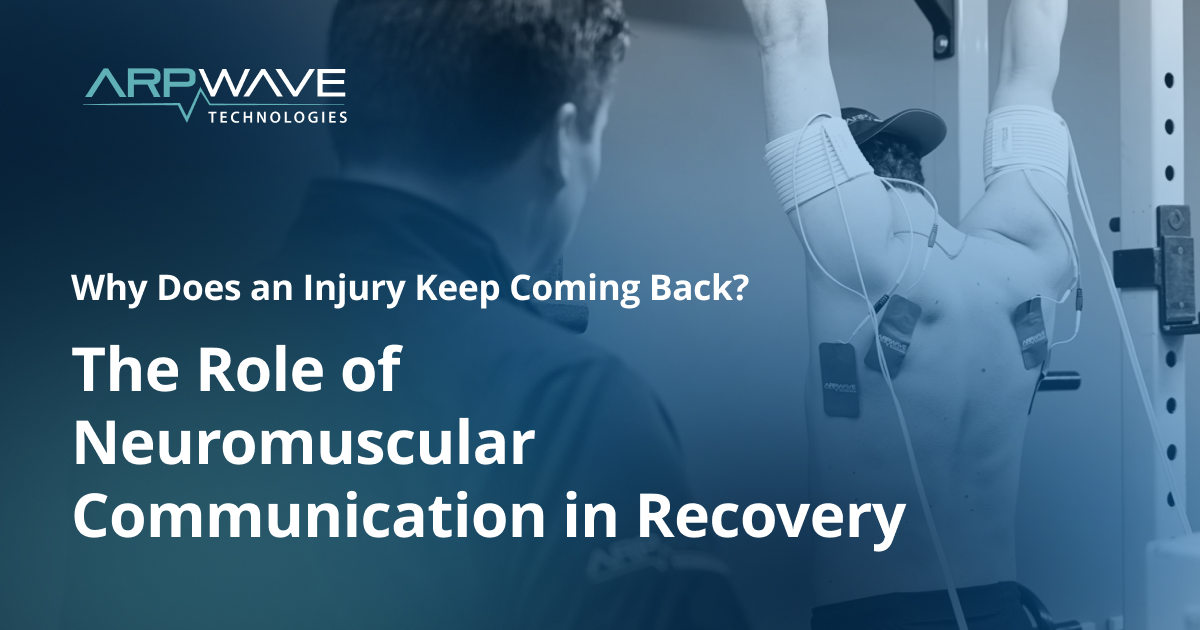
Why Does an Injury Keep Coming Back? The Role of Neuromuscular Communication in Recovery

An injury can seem to keep coming back when healing, strength, range of motion (ROM), balance, or movement control have not fully recovered, or when activity exceeds what the body can currently tolerate. Neuromuscular communication can be part of that picture. Understanding how your nervous system and muscles work together may help explain why feeling better and restoring function do not always happen at the same time.
You rested, completed rehabilitation, and gradually returned to your normal activities. For a while, everything seemed to be moving in the right direction. Then the same area started giving you trouble again. That experience deserves a closer look, but recurring pain does not automatically mean a new injury has occurred. A provider can assess whether you are dealing with re-injury, ongoing irritation, instability, or another condition, and whether your recovery plan addresses the demands of your daily life or sport.
Why an Injury May Keep Coming Back
When symptoms return, it is useful to examine both the injured tissue and how you are using it. Your provider may assess whether healing is complete, whether joint stability and muscle capacity have recovered, and whether you resumed demanding activity too quickly. An ankle sprain illustrates the issue: the American Academy of Orthopaedic Surgeons explains that inadequate treatment and rehabilitation can leave the ankle vulnerable to another sprain. Previous injury, poor balance, and ligament instability can also matter. Recovery therefore requires attention to the specific injury and the function you need to regain.[1]
Neuromuscular control is another consideration. Walking comfortably around the house places different demands on your body than running, landing, or changing direction. An area may feel better during ordinary activities while still needing work before it can tolerate sport or heavier physical tasks. Assessing those demands helps a provider identify what remains limited and build an appropriate progression. There is no single explanation for every recurring injury, which is why the assessment should guide the plan.
What Neuromuscular Communication Means for Recovery
Neuromuscular communication is the interaction between your nervous system and muscles that coordinates movement. Your brain and spinal cord help regulate muscle activation, while sensory information from your body helps you adjust position, balance, and force. Following an injury or surgery, that process can change. One example is arthrogenic muscle inhibition, in which signals associated with an affected joint can limit muscle activation. In a laboratory study of experimentally induced knee swelling, researchers found that changes in quadriceps activation were associated with changes in strength and walking mechanics. This helps explain why clinicians may evaluate muscle recruitment alongside muscle size and strength.[2]
Rehabilitation can address these issues through appropriately selected exercise, balance work, coordination training, and practice of the movements a person needs to perform. Clinical guidelines for lateral ankle sprains, for example, include active ROM, neuromuscular training, and balance exercises within structured rehabilitation. For chronic ankle instability, they recommend proprioceptive and neuromuscular exercise to improve stability during function. The appropriate combination depends on the injury, stage of recovery, and findings from the examination.[3]
How Compensation Patterns Affect the Kinetic Chain
Compensation patterns are adjustments your body makes to complete a task when movement is painful, restricted, or difficult. Imagine someone who avoids putting weight through an ankle after an injury. They may shorten a step, shift their weight, or use their hip and trunk differently. These adjustments can be useful during recovery, but they also give the provider information about how the person is managing movement. A different movement pattern is not automatically harmful; the question is whether it fits the task and the person’s current capacity.
The kinetic chain describes how connected body regions contribute to movement. Running involves the foot, ankle, knee, hip, pelvis, and trunk, while throwing also depends on contributions beyond the shoulder and arm. That is why a provider assessing a knee may examine the ankle and hip, or assess trunk movement during a shoulder evaluation. Looking at these relationships can broaden the assessment, but an observation elsewhere in the body does not, by itself, prove the cause of the original injury.
Why ROM and Function Both Matter for Functional Health
ROM stands for range of motion, the amount of movement available at a joint. Function describes how you use your movement, strength, balance, and endurance to accomplish a task. A shoulder may have enough ROM to reach overhead while still lacking the capacity to lift a suitcase repeatedly. An ankle may move well during an examination while balance or confidence remains limited on uneven ground. Measuring ROM is useful, but it should be considered alongside the activities you want to resume.
In this article, functional health means your ability to carry out everyday activities and the physical demands that matter to you. That could mean taking the stairs, working a full shift, lifting your child, or returning to competitive sport. Recovery goals become more meaningful when they reflect those activities. Your provider can use relevant measures of ROM and function to establish a baseline, assess progress, and decide when to increase the challenge.
How ARPwave NeuroTherapy Approaches Injury Recovery
ARPwave NeuroTherapy combines direct-current electrical stimulation with movement assessment, active exercise, and reassessment. To learn more about the development of this approach, explore the history of ARPwave. The ARPwave device and its application guidelines work together within an individualized approach. A trained provider may begin by observing a movement that relates to your goals, such as walking, squatting, or reaching, then incorporate stimulation and appropriate movement to work on muscle recruitment and coordination. You can learn more about the approach through ARPwave’s neuromuscular therapy information.[4]
In the assessment, intervention, and reassessment process described here, the provider repeats a relevant movement to observe how you respond. Changes in ROM, comfort, or task performance can help guide the next step, including whether to adjust the exercise or examine another part of the kinetic chain. An immediate change is useful feedback, but it does not establish that tissue has healed or that re-injury risk has been eliminated. Progress also needs to be evaluated over time and under the demands you plan to return to.
What Research Says About Reducing Re-injury
Research supports the value of specific exercise programs for certain recurring injuries. In a randomized trial involving 522 athletes after an ankle sprain, an eight-week home proprioceptive training program added to usual care reduced self-reported recurrent sprains over one year. Recurrence was reported by 22% of the training group and 33% of the usual-care group. This provides a practical example of how training balance and movement control can contribute to recovery beyond the initial reduction in symptoms.[5]
That study evaluated a particular exercise program, not ARPwave, so its findings should not be presented as proof that ARPwave prevents re-injury. It does support a broader point: recovery planning can benefit from attention to the skills and physical capacity needed for activity. Electrical stimulation, when appropriate, should be considered within a plan that also accounts for tissue healing, progressive exercise, and the individual’s response.
Common Questions About Recurring Injury
Does recurring pain mean I have re-injured myself?
Recurring pain alone cannot establish whether a new injury has occurred. A provider considers your symptoms, injury history, examination, and any further testing needed to understand what has changed. That distinction matters because a new injury and a flare of existing symptoms may require different next steps.
Can full ROM mean I am ready to return to sport?
Full ROM is one part of recovery, but it does not measure everything required for sport. Strength, balance, movement control, and tolerance for the specific activity also matter. Your provider can assess these factors together rather than relying on a single measurement.
Why would my provider assess somewhere other than the painful area?
Several body regions contribute to most functional movements. Examining the ankle and hip during a knee assessment, for example, can help a provider understand how you perform a task. Those findings add context to the examination of the area that is bothering you.
Take the Next Step Toward Better Function
If an injury keeps interrupting your routine, ask whether your recovery plan addresses the movement and physical demands you want to return to. Understanding ROM, muscle recruitment, and whole-body function can help make that conversation more specific. Contact ARPwave to discuss your goals, learn about NeuroTherapy, and ask about connecting with a trained provider. Visit arpwave.com/contact-us/ or call (952) 431-9708.[6]
Article References
[1] American Academy of Orthopaedic Surgeons. Sprained Ankle. Read source
[2] Pietrosimone B, et al. Changes in voluntary quadriceps activation predict changes in muscle strength and gait biomechanics following knee joint effusion. Clinical Biomechanics. 2014;29(8):923–929. Read source
[3] Martin RL, et al. Ankle Stability and Movement Coordination Impairments: Lateral Ankle Ligament Sprains Revision 2021. Journal of Orthopaedic & Sports Physical Therapy. 2021;51(4):CPG1–CPG80. Read source
[4] ARPwave. What is ARPwave Neuromuscular Therapy. Read source
[5] Hupperets MDW, Verhagen EALM, van Mechelen W. Effect of unsupervised home based proprioceptive training on recurrences of ankle sprain: randomised controlled trial. BMJ. 2009;339:b2684. Read source
[6] ARPwave. Contact Us. Read source